Davy notes: This post on aged Ridge wines is from Leon Marks, but I wrote the section on and tasting notes of the Zinfandel Blends and Mataros
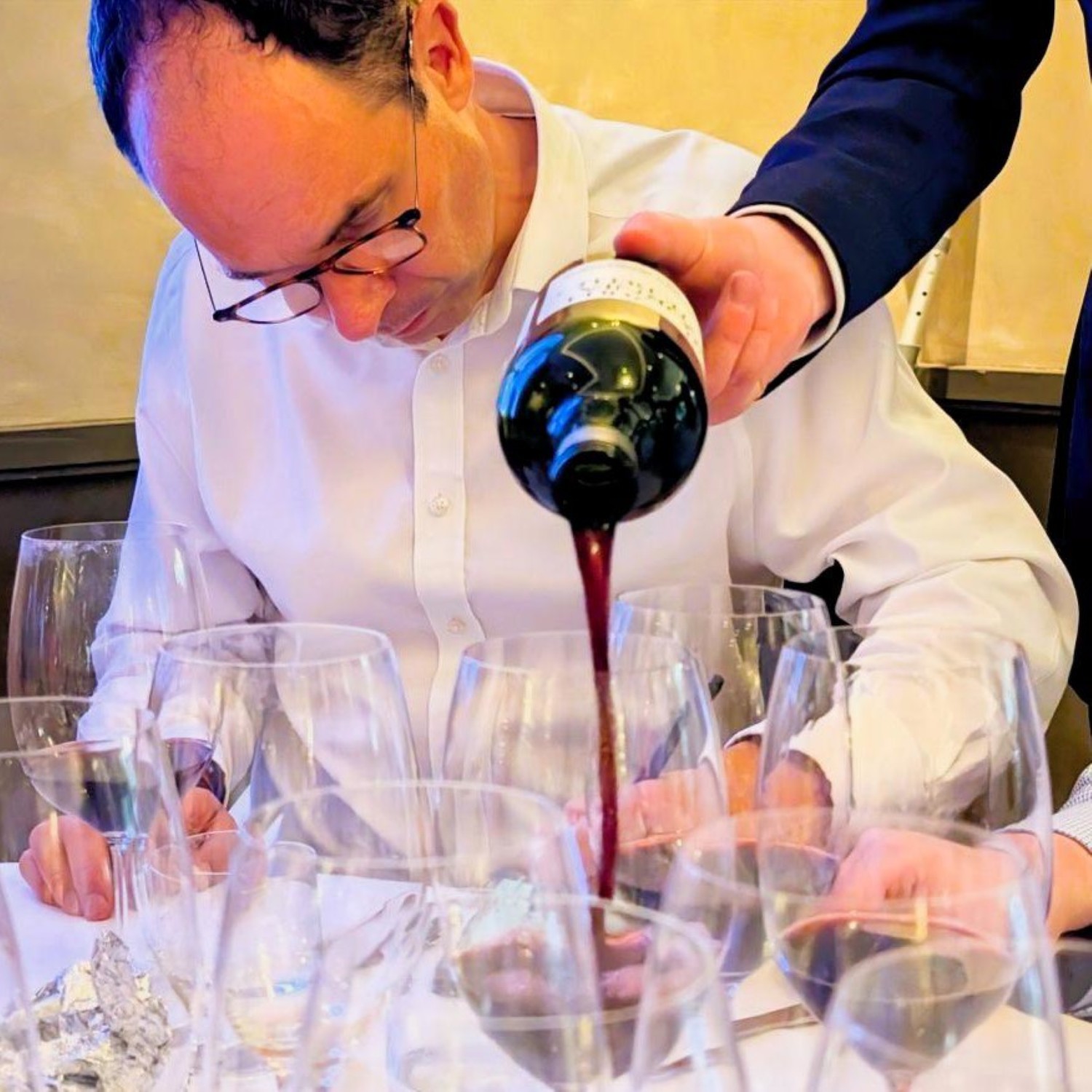
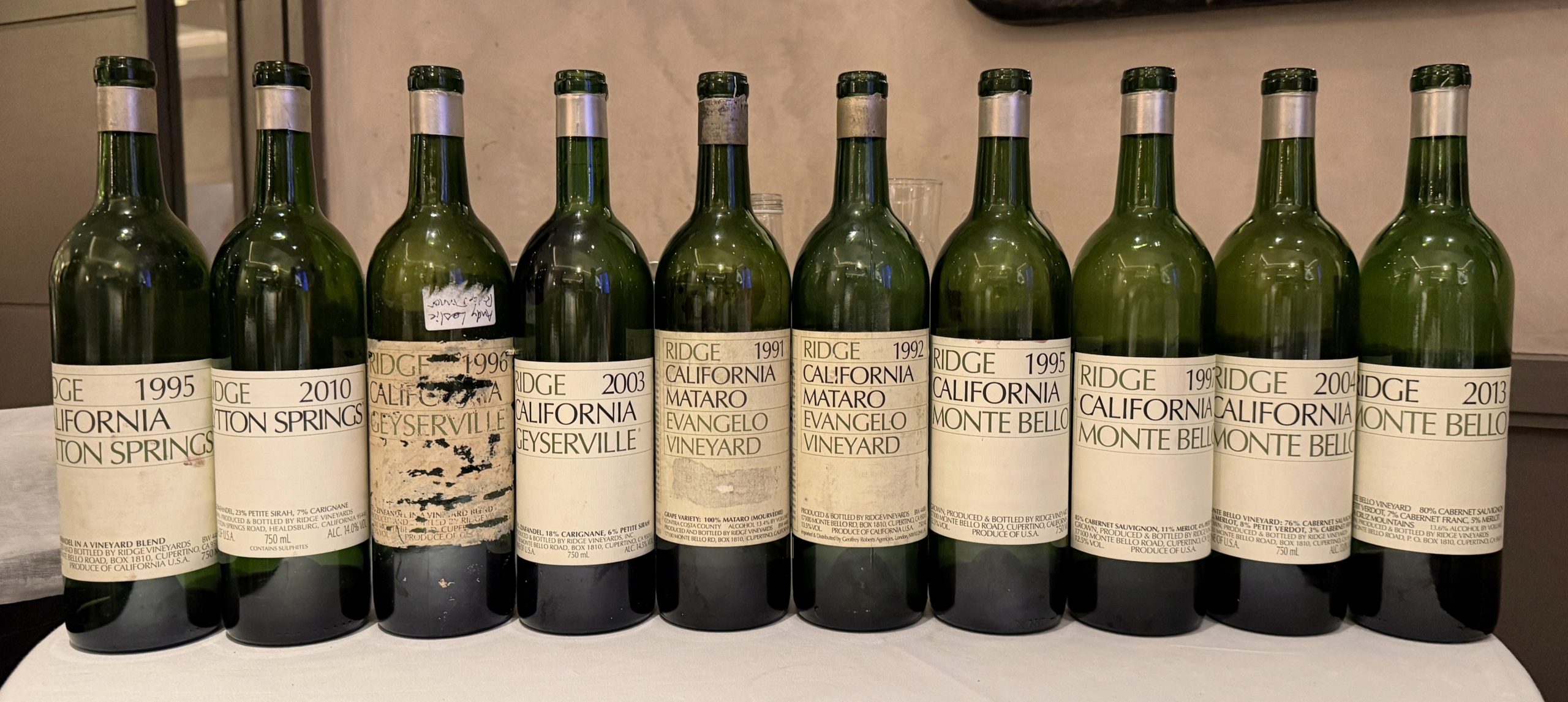
Eight of us met at La Trompette in Chiswick to enjoy a blockbuster tasting of the wines of aged Ridge Vineyards. As I have written previously, here and elsewhere, Ridge is the single producer I love the most.
We wanted to taste a range of their top reds. The Monte Bello is the top of the shop, famously placing fifth in Steven Spurrier’s 1976 Judgment of Paris tasting. It has been described as the Chateau Latour of California.
The Cabernet-based wines – the Monte Bello and the various incarnations of the Estate wines – are superb. They are also known for their Zinfandels and Rhône blends, which express their savoury, structured, terroir-driven characteristics through boozier, less refined grapes.
As we found out, the Zinfandels and Rhône varietals can age as well as the Monte Bello.
Ridge believes in letting the character of the terroir speak through the wine. They practice what they describe as ‘preindustrial’ wine making, with minimal intervention. Fermentation is with native yeasts from the vineyard rather than cultured strains. The malolactic is left to occur on its own, with naturally occurring bacteria and no inoculation.
Zinfandel and Mataro flight
Both Leon and I have been of the view that Ridge’s premium Zinfandel blends can age far longer than the drinking windows given on their labels. This evening we were fortunate to have examples of them going back over 30 years.
I am not an expert enough Zinfandel taster to determine what effect the terroir of Ridge’s top two vineyards has on the final wine. Moreover, the wines are made from slightly different cepages, and I feel it is these different varietal compositions that markedly effect the character of the final wine. Specifically, it is the character of the second most planted varietal in the field blend that has maximal effect.
Lytton Springs is planted with roughly 75% Zinfandel and 20% Petite Sirah (plus a few others) – the exact proportion of the juice from these grapes that makes it into the final wine depends on the relative growing success of them.
Petite Sirah is nothing to do with Syrah. It is known in France as Durif. The grape is thick-skinned so produces a dark, very tannic wine. Once you have tried a single varietal Petite Sirah, you will be so struck by its characterful nature that, unless the proportion of the grape is very low, it is always easy to spot in a blend. I find it has a loganberry-cum-boot polish aroma that is far more attractive than it sounds. It is vaguely reminiscent of Petit Verdot.
Geyserville, on the other hand, is planted with a tiny bit less Zinfandel and just under 20% Carignane. There is a little Petite Sirah and Mataro (aka Mourvèdre/Monastrell) as well.
Carignane produces bunches of quite large grapes, with thinner skins, so in the fermentation there is a lower skin-to-juice ratio. Consequently, the final wine is lighter in colour than Lytton Springs and a little less tannic. Carignane also has higher acidity, making the final wine more perky and energetic.
Finally, the Mataro wines come from a vineyard that was co-planted with several varietals in the 1890s. Ridge sourced Mataro from this vineyard in the early 1990s, then lost access to the fruit. In 2018 they were offered access to fruit from the vineyard and since then they have made an excellent field-blend from it. This 1991 and 1992, however, are pure Mataro(/Mourvèdre/Monastrell).
One very pleasing characteristic of these six Ridge wines and, indeed, all the wines in this tasting, is that they smell and taste of Ridge wines. That is to say, the combination of winemaking techniques, such as natural ferments and use of the finest American oak, mark the wines with a distinctive house-style. Leon and I are firmly of the opinion that the house-style is attractive and speaks of quality and panache.
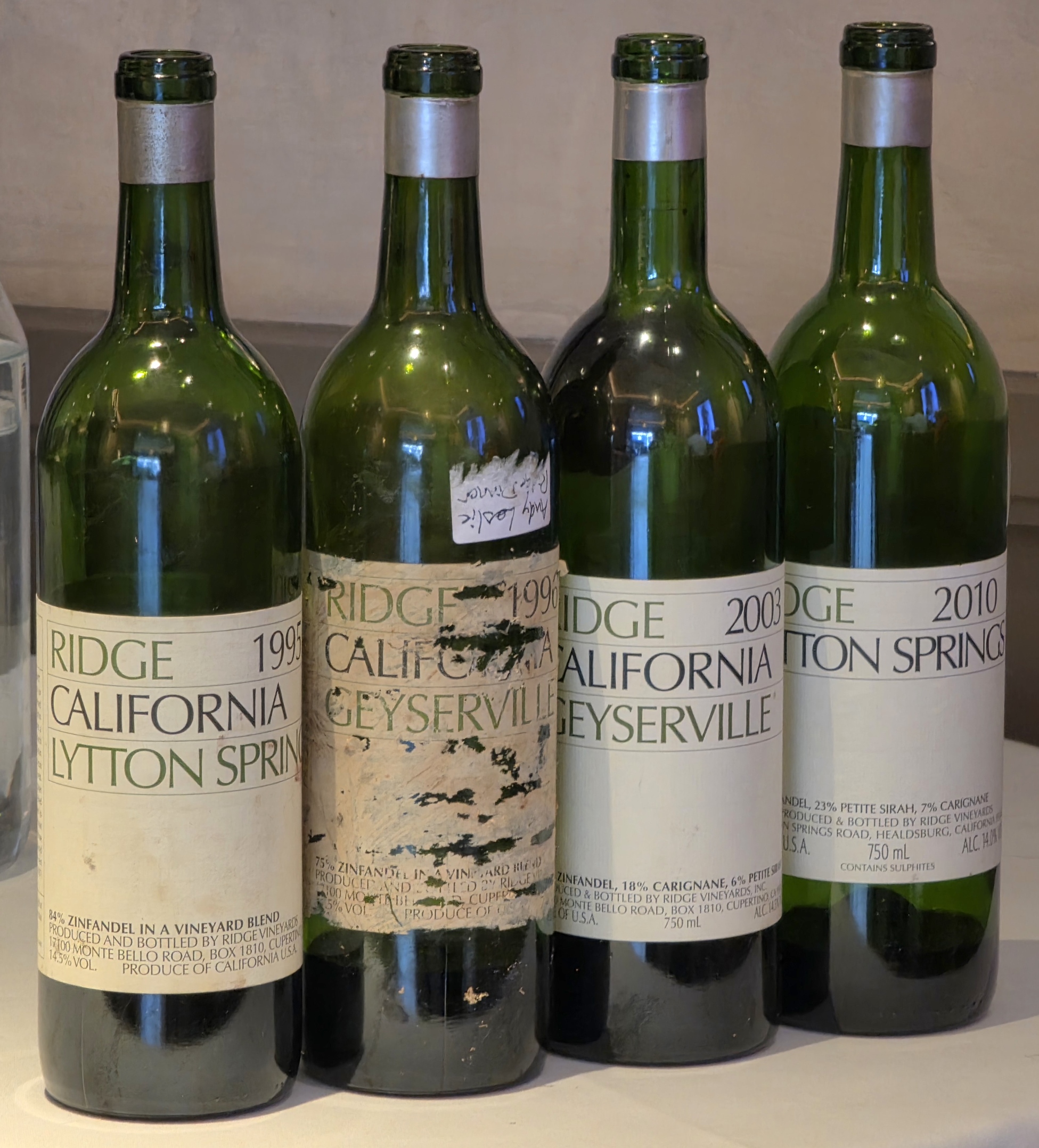
Lytton Springs 1995, Ridge
14.3%. 84% Zinfandel, 14% Petite Sirah, 2% Carignane.
Definite bricking to the colour, but still dark. The nose is of a fully mature wine (the fruit is softer rather than vibrantly fresh and everything is mellow and velutinously stated) and is a delight because of that.
The Zinfandel and Petite Sirah fruit have combined synergistically as they have aged to display a wonderful character that seems elixirate, like an old-fashioned herbal cough cordial. All the wood has been digested and consumed into the wine, creating a palimpsestic set of flavours
The palate has a soft and tremulous tannic structure, plush fruit and a refined earthiness that give it a kaleidoscopically complex character. This is clearly up for drinking, and at 31 years old you are going to experience some bottle variation. Get one like this, and you will pleasure yourself immensely.
Geyserville 1996, Ridge
14.9%. 75% Zinfandel, 17% Carignane, 8% Petite Sirah, 5% Mataro.
This is less bricked but at its core it is more lightly coloured. Although it is definitely showing tertiary susurrous complexity, it smells a lot fresher and more vivacious. There is clearly red fruit showing here.
The palate is remarkably energetic for a 30-year-old wine. The fruit may be more understated but the bramble of Zinfandel and raspberry-ish flavours of Carignane are still discernible. Tannins are soft but clearly present, and there is the merest hint of vanilla-oak flavour. Winningly involute.
An excellent bottle of a very attractive 30-year-old wine, one does not get many as good as this! It is also very clearly Geyserville and is still charged with the house style. Wonderful!
Geyserville 2003, Ridge
14.6% 76% Zinfandel, 18% Carignane, 6% Petite Sirah.
What a glory! Pulsing with life and charged with bramble and raspberry fruit – nosing this blind one would find it difficult to guess it was over 20 years old. The aromas are speaking with a single voice, but I cannot help but be surprised by the vibrancy of this nose.
It still has plenty of freshness, with distinct energy and the beginning of a tessellate character to the fruit, the flavours are starting to meld into a complex whole with age. It is sweetly scented and polished.
Whilst this is lively, the complexity of significant age and slight softness are exactly what I want from an aged Ridge Zinfandel blend. It throbs with the character of a Ridge wine. For me, this approaching the platonic ideal of a Geyserville, I absolutely adore it! Chapeau!
Lytton Springs 2010, Ridge
14.4%. 67% Zinfandel, 23% Petite Sirah, 7% Carignane, 3% Mataro.
If the previous wine was a wonderful example of an aged Geyserville, wow this is a great, aged Lytton Springs! It is still broodingly dark and you can almost feel the Petite Sirah rich loganberry-cum-boot polish-cum-phytic tincture aromas exuding from it. Absolutely delicious!
Tannins are strong, with a softening edge, but it is sumptuously structured and polished. Highly attractive – as lubricious enough to get into the ‘fornicators’ circle of hell. There is certainly vivacity, but not as perky as the previous wine. The fruit is so attractive you could bite its arse.
By thunder, I love this wine! Maybe it could do with a few more years, but sixteen is approaching peak Lytton Springs for me. Alas, I only have one bottle of the wine approaching this age, a 2011; at least I know I do not have to wait too long before I can have rumpy-pumpy with it!
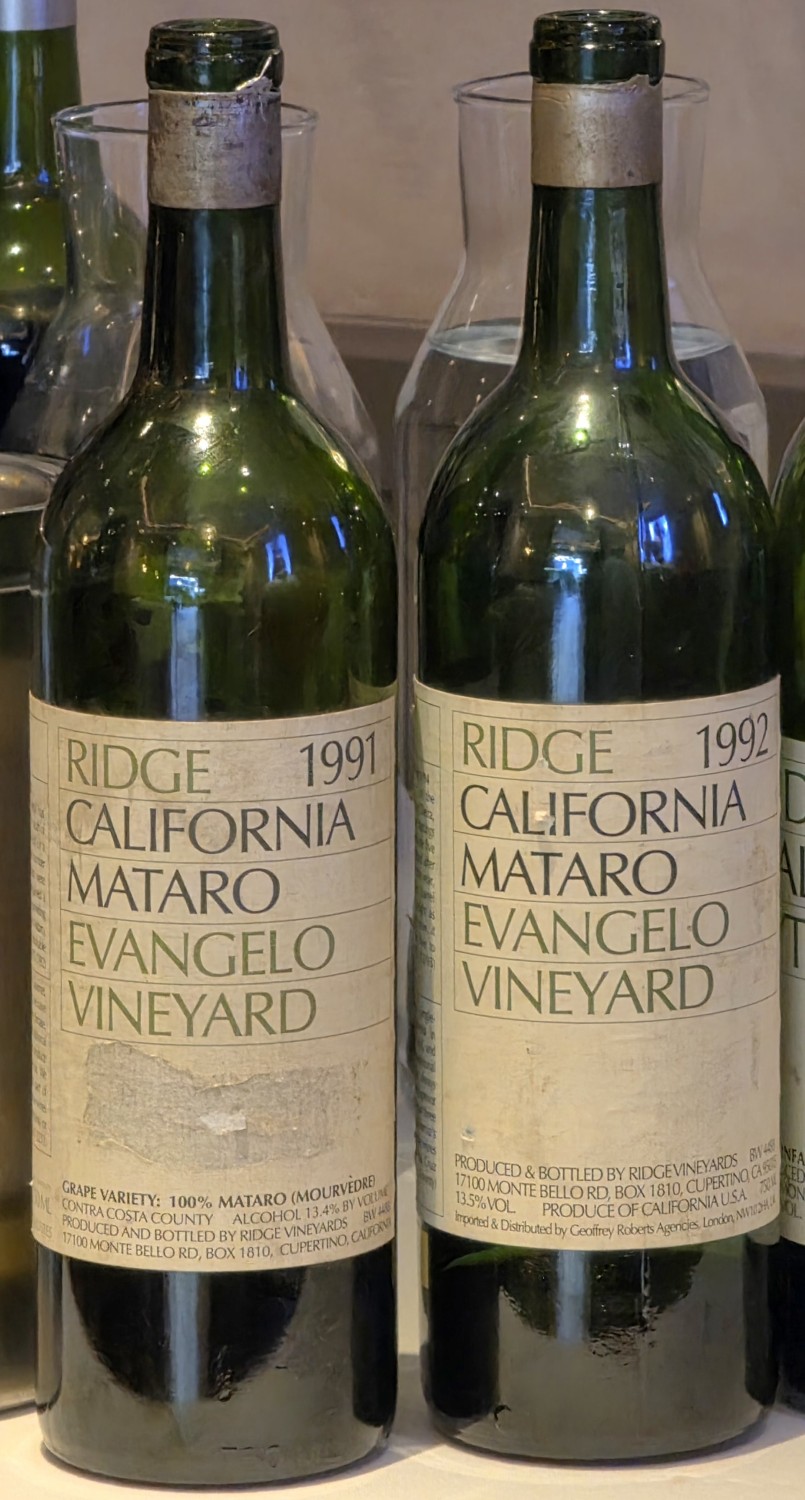
Mataro Evangelo Vineyard 1991, Ridge
13.4%.
At 35 years old, this is ‘old wine’ rather than Mataro from the Evangelo vineyard (expression of terroir diminishes with age and wine becomes ‘old’ rather than a specific wine from a specific place). That does not mean it is bad, it is in a very pleasing state of decay.
Very soft, with shades and hints of subtle fruit aromas and a touch of earth. It is complex, but I can almost feel that complexity slipping away as I swirl and taste. Delicate, but still winsome, but this certainly would have been better at some point in the past. Quite when in the past I find exceedingly difficult to judge given the state of the next wine.
Mataro Evangelo Vineyard 1992, Ridge
13.5%.
What a difference a year less age and 0.1% more alcohol make! This is a great, expressive, completely lovely old Mataro that shows all the complexity the varietal can deliver with age.
It has heaven-sent scents of grilled meat, earth and spicy, plummy fruit that resembles Port-fruit, but not in a hot, booze-tastic manner. Oh, how I love aged Mourvèdre!
One would get the varietal and have a wild stab of the age of this wine blind, but one would never mistake it for a Bandol. I think it is remarkably clean for a grape that usually has Brett as varietal character! Certainly hieratic‑intricate, though, the complexity is dazzling.
It has remarkable freshness and energy for this grape at this age – we are told this is the character of the vineyard. Clearly a great, great vineyard and I love this wine so much I have just bought some of Bedrock’s field blend from it. An absolute stunner and I feel extremely fortunate to have tasted this wonder!
Monte Bello flight
The Monte Bello vineyard sits at 1,300 to 2,700 feet above sea level in the Santa Cruz mountains, south of San Francisco. The winery describes it as composing “unique green stone and clay soils, layered over decomposing limestone”. Limestone is not found in the well-known Cabernet areas of Napa and Sonoma. It gives the wines a mineral grip on the finish.
The climate also contributes. The vineyard is just 15 miles from the Pacific, and the ridge is the first wall against the cold ocean air and fog hit, acting as an air conditioner over the vineyard.
The vineyard was originally planted in 1885 by Osea Perrone, an Italian doctor. He terraced the slopes, planted vines and built the three-story winery, which stands to this day.
During prohibition, the vineyard fell into neglect and was effectively abandoned by the 1940s. The vineyard was replanted with 8 acres of Cabernet Sauvignon in 1949. In 1959 a group of Stanford Research Institute researchers bought the land, and decided the resulting wine was good enough to start producing the wine commercially.
One of my favourite family photos is of my wife, our two children and me in front of the Monte Bello sign at the winery. If you ever get the chance to visit, I highly recommend it. The drive to the top of the hill is beautiful, and to me visiting the tasting room is visiting hallowed ground.
My impression of Monte Bello is that it is part Left Bank Bordeaux. Precision, a kind of pencil-lead/cigar box character, middle weight with fine tannins and lovely structure. The other part is Technicolor California – lovely fruit energy and a kind of bubble-gum character that I think owes something to the large proportion of American oak it is aged in.
The four Monte Bellos we tasted were excellent expressions of the wine, at different stages of maturity. The wine gods blessed us that evening.
Anyway, onto the wines themselves.
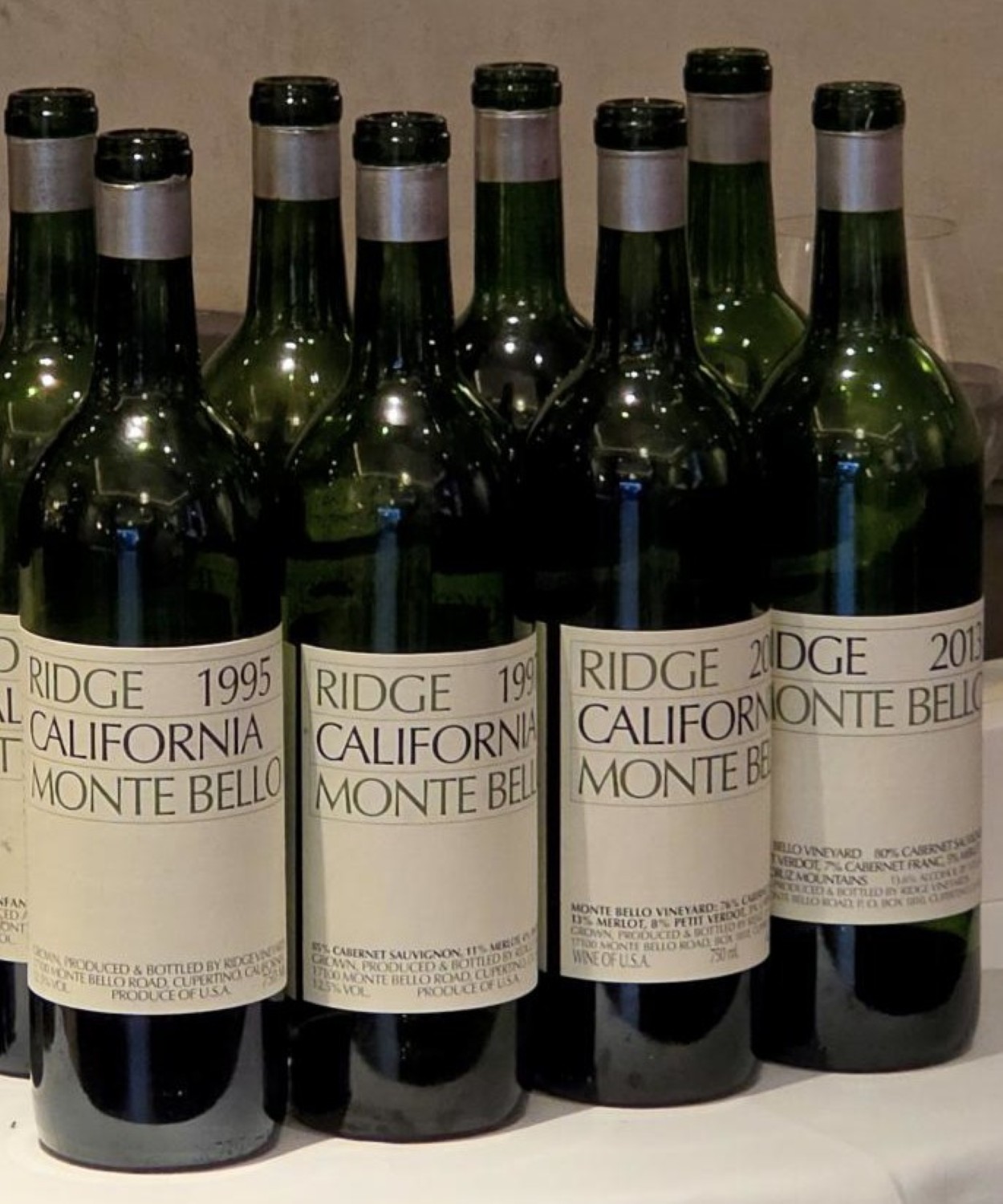
Monte Bello 1995, Ridge
12.5% abc. 69% Cabernet Sauvignon, 18% Merlot, 3% Cabernet Franc, 10% Petit Verdot.
A vintage I have been lucky enough to taste several times – the first time at the winery itself. Ridge evidently consider this one of the best wines of the 1990s, and one of the longest lived, with powerful tannins.
The colour was described by someone described it as ‘quite purple’ and indeed it was. Lovely energy on the nose, some red fruit, a hint of spice and some pencil lead. On the palate a fellow diner said ‘sex-mongous’ and I agree.
There is a hint of lactic character on the finish. This is very good but not the best bottle I have drunk of this vintage. With 30 years in bottle, I suppose some variation is expected.
Monte Bello 1997, Ridge
12.9% abv. 85% Cabernet Sauvignon, 8% Merlot, 4% Petit Verdot, 3% Cabernet Franc.
Another vintage I have tasted a few times, albeit not quite as frequently as the 1995. This was even more purple. The nose seemed younger and fresher by comparison.
On the palate – oh wow. My defences evaporate. This wine could ask me for anything, and I would say yes. There is the structure, yes. The minerality and savoury character, yes. There is also a joyous berries and fruit intensity. Not the best Monte Bello we tasted, but the most uncomplicatedly joyous.
Monte Bello 2004, Ridge
13.2% abv. 76% Cabernet Sauvignon, 13% Merlot, 8% Petit Verdot, 3% Cabernet Franc.
My first time tasting this vintage. Still so many years ahead of it but so joyous right now. One gets the cool mountain acidity; the red and blue fruit is right there in the middle of the palate but held in place with great finesse.
A fellow diner described this as being at a ‘turning point’ – it is no longer a young wine. One can drink these free of guilt, but they are only really at the beginning of the zone. A toss up for me whether I enjoyed this or the 1997 more on the night. A truly lovely Monte Bello.
Monte Bello 2013, Ridge
13.6% abv. 80% Cabernet Sauvignon, 8% Petit Verdot, 7% Cabernet Franc, 5% Merlot.
A bruiser of a wine. Interestingly, aged in 98% American Oak and 2% French – usually the proportions are closer to 90/10. Those critics who use numbers thought very highly of this indeed. You really get the structure here, the earth and minerality sitting beneath this incredible package of world class fruit.
My first time tasting this wine was with the proprietor, about two years ago. This is awesome, so young, so tightly coiled, but so clearly brilliant. This is a precocious teenager for sure, but so talented you will forgive it anything. A fellow diner said “Tits, man!”, and yes indeed.
So, what did we learn? Well, up and down the range, Ridge is one of the finest red wine producers in the world. They source grapes from a range of terroirs – it is not just luck. They have a philosophy and a craft that enables them to deliver consistent brilliance, in a way that speaks to my soul.


Wow!
Quite some line up and excellently conveyed by the co authors.
I was particularly interested to read the description of the 1997 Montebello, as that was my first exposure to Ridge courtesy of “The Don” (Reid) circa 2010.
I remember thinking it tasted like a first growth claret but cut from unfaded cloth.
Not perhaps that far away from the expert opinion expressed here a decade and a half on.
Great work all!
Good morning, Ray,
Obviously, Leon is the MB expert, but I hope he will not mind if I comment. The thing that really compelled me about the MB’s was their savoury, mineral character. This is really fantastic in any wine, especially a Californian Cabernet. They were certainly fully ripe, but lovely and savoury. In that sense, they were like the best Clarets one encounters. Leon quotes an unnamed source describing it as the Latour of California. I hate Latour. Maybe Lafite… Maybe…
Ha – the unnamed source was the late Harry Waugh. He was the chief buyer for Harveys of Bristol, and sat on the board of Ch Latour. I don’t have a great deal of experience with Latour, but I chose this quote as I felt it accurately reflected my view that these are like a left bank claret, but in a more Technicolor, energetic register.
I might be deluding myself but there’s a certain character to the air in Northern California, something to do with the smell of the redwoods I think, that ends up in these wines.
Anyway Ray – I think your description is perfect.
I met Harry Waugh! He turned up to an Oxford-Cambridge blind tasting competition to be encouraging. It was amazing to meet him, supposedly the greatest blind taster who has ever lived! He had lost his sense of smell at that point, but we poured him a slug of the wine that we had brought along to fox James ‘Porker’ Simpson, the MW from Pol Roger who ran the competition. Harry said, “Obviously, I cannot taste this, but it has the texture of La Chapelle 1978.”
It was La Chapelle 1983.
But enough bragging about the wine gods I have met. Undoubtedly a left bank character, but something far more pleasurable than the joyless Latour.
Hmmmm… Now I think about it, people with access to far flasher wine than me tell me Latour has got one hell of a lot better in recent… oohhh… decade? I may be unfairly maligning it, but the 45, 55, 61 and 75 were awful. Just awful.
I look forward to being educated on just how bad all that Latour tastes.