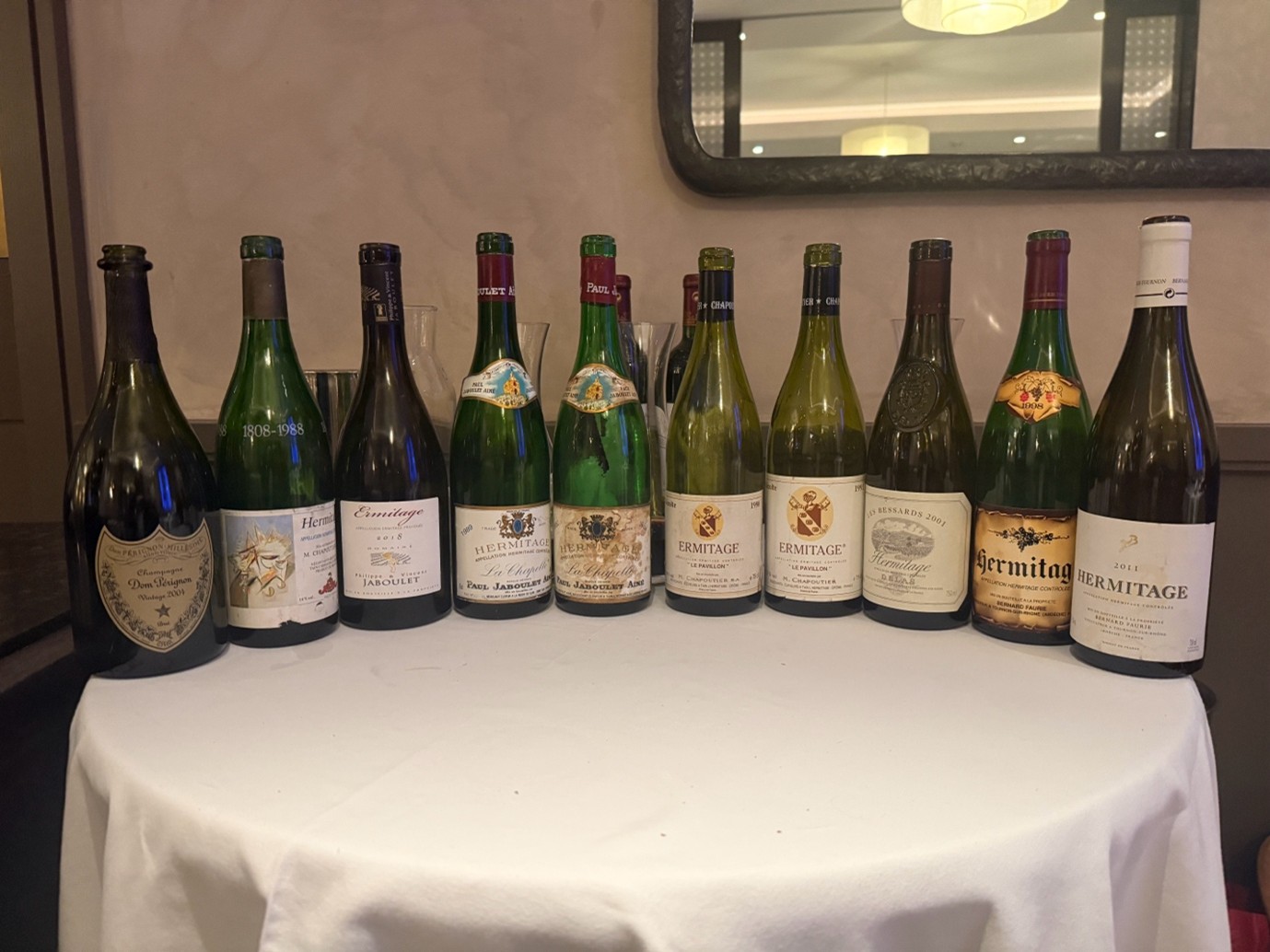
The theme of the dinner was Hermitage. It is one of the three great appellations of the Northern Rhône, along with Cornas and Côte-Rôtie, and probably the one I know least well. The core of the dinner was built around a pair of old vintages of La Chapelle from Paul Jaboulet Aîné.
Historically this was an iconic wine. The 1961 was famously said to surpass even the Château Latour of the same year. I am sorry to report I have tasted neither. More recent vintages I have encountered have been more than decent, but not transcendent in the way that Northern Rhône Syrah can be.
The restaurant was La Trompette in Chiswick. This is possibly my favourite restaurant in the world. The top table at our wedding was named after it. The food and service are flawless. The proprietor has a deep love of wine, and our nerdy tribe is made more than welcome by the excellent front of house staff.
Their usual offering is a prix-fixe two or three course meal. They kindly accommodated the food volume we would require for our marathon wine consumption, and gave us a deal on two starters, a main and some cheese.
Champagne Brut 2004, Dom Pérignon
This was my wine, and I was a little conflicted about bringing it. On the one hand, blingy brand names are a bit infra dig with this crowd. On the other, the only bottles of Champagne I had in the house were this, and an altogether more humble Roederer Collection 243. The Roederer is certainly very good, but I have shared bottles with most of the participants of this dinner in the past, and given the calibre of wines we were due to taste, I thought I should bring something a little more special.
On to the wine. Pale straw colour. On pouring, a little butyric grumpiness, but it soon got into shape. It has that energy and effervescence I associate with Dom, and a kind of yeasty, bready completeness. There is a sweetness to the mid-palate, but nothing cloying, more a knowing hint of richness that does not need to brag.
I always find Champagne notes harder to write than those for still white or red wine, but typing these up inspired me to buy more bottles for my cellar. Even the least champagne-focused wine aficionados at the table agreed this was a lovely wine.
Is this at its peak? I do not know. It is fully ready and very engaging, but there is still freshness. I was hoping for special, and special we got.
Salmon sashimi with pickled rhubarb dressing, white soy, crème fraîche and pistachios.
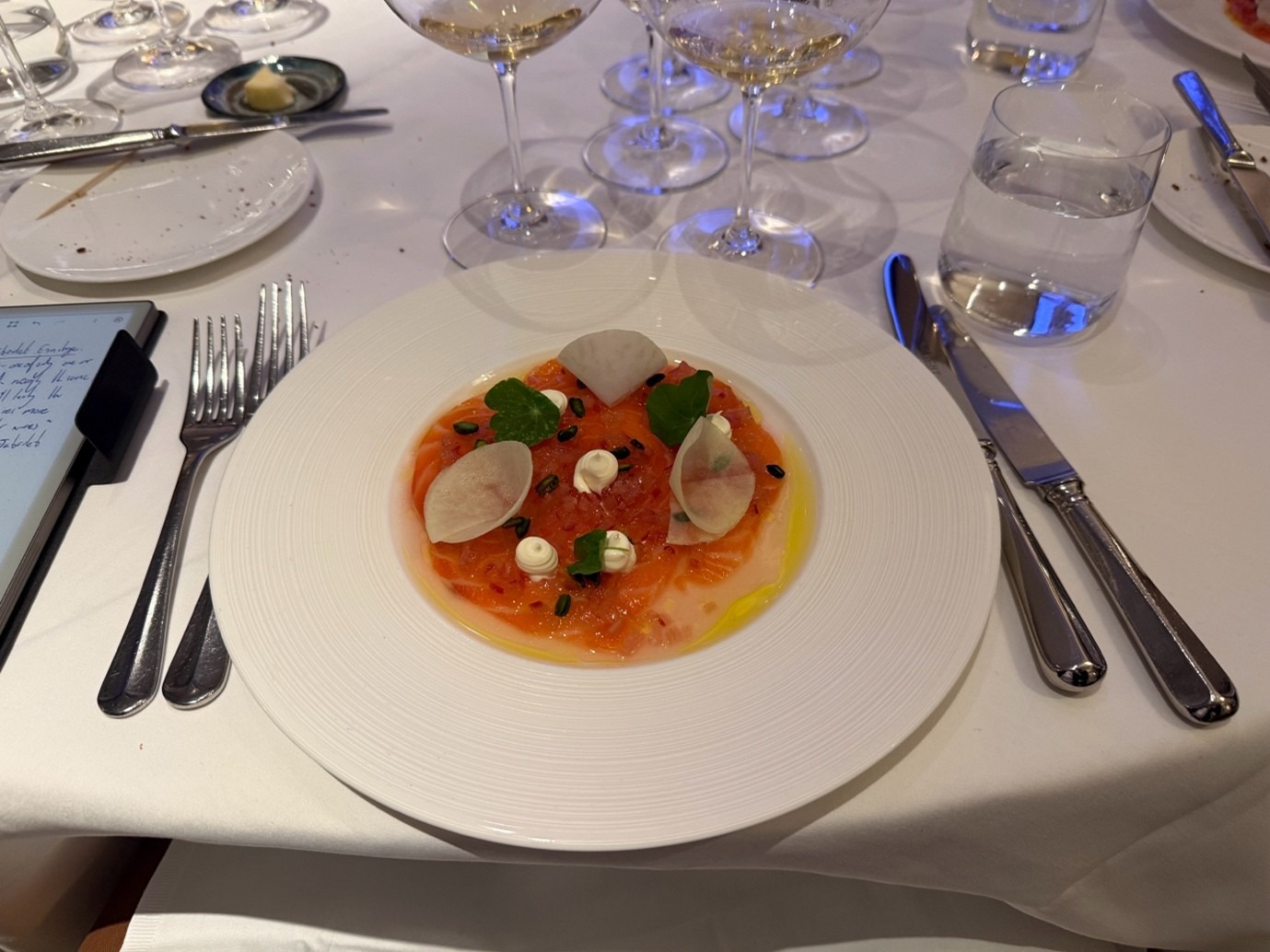
This looks like one of those light, tart ceviche dishes that have become so popular in London. It is not. It is exactly what it says it is: superb sashimi-grade salmon, with an elevated but delicate dressing that does nothing to challenge the wine and leads to a harmonious whole. Flawless.
Hermitage Blanc 180th Anniversary 1986, Domaine Chapoutier
14% abv. Marsanne. I am a Northern Rhône white sceptic. I struggle with the lack of acid. This has a deep golden colour and, on pouring, a funky nose. This blows off. There is real definition here, and slabs of butterscotch on the finish, albeit not very sweet butterscotch.
There is a character that is almost, but not quite, like skin contact. I am informed this is phenolic bitterness. There is a bitterness here, but it does not linger. There is a flinty character at the end. This is superb. A privilege and a joy to drink.
Ermitage Blanc 2018, Domaine Philippe et Vincent Jaboulet
14% abv. Roussanne. When the eponymous family domaine was sold to the Swiss Frey family in 2006, Philippe, who had previously managed the family vineyards, bought an old domaine with his son Vincent and started again.
In spite of more than forty years separating this wine and its flightmate, this is a good pairing. The colour is almost exactly the same shade of gold. There is still that lack of acid on the finish that I find off-putting. A fellow diner remarked that this “requires more stage setting than other wines.” Certainly it paired well with the food and had a lovely savoury quality.
We had some discussion about the ageability of this. If it were to follow a similar trajectory to the Chapoutier, that would be a treat indeed.
In the nineteenth century, white Hermitage was considered the equal of Le Montrachet as one of the great white wines of the world. I am still to be convinced, but I am enjoying being educated.
Crisp pork belly and black pudding terrine, caramelised apples, mustard and crackling.
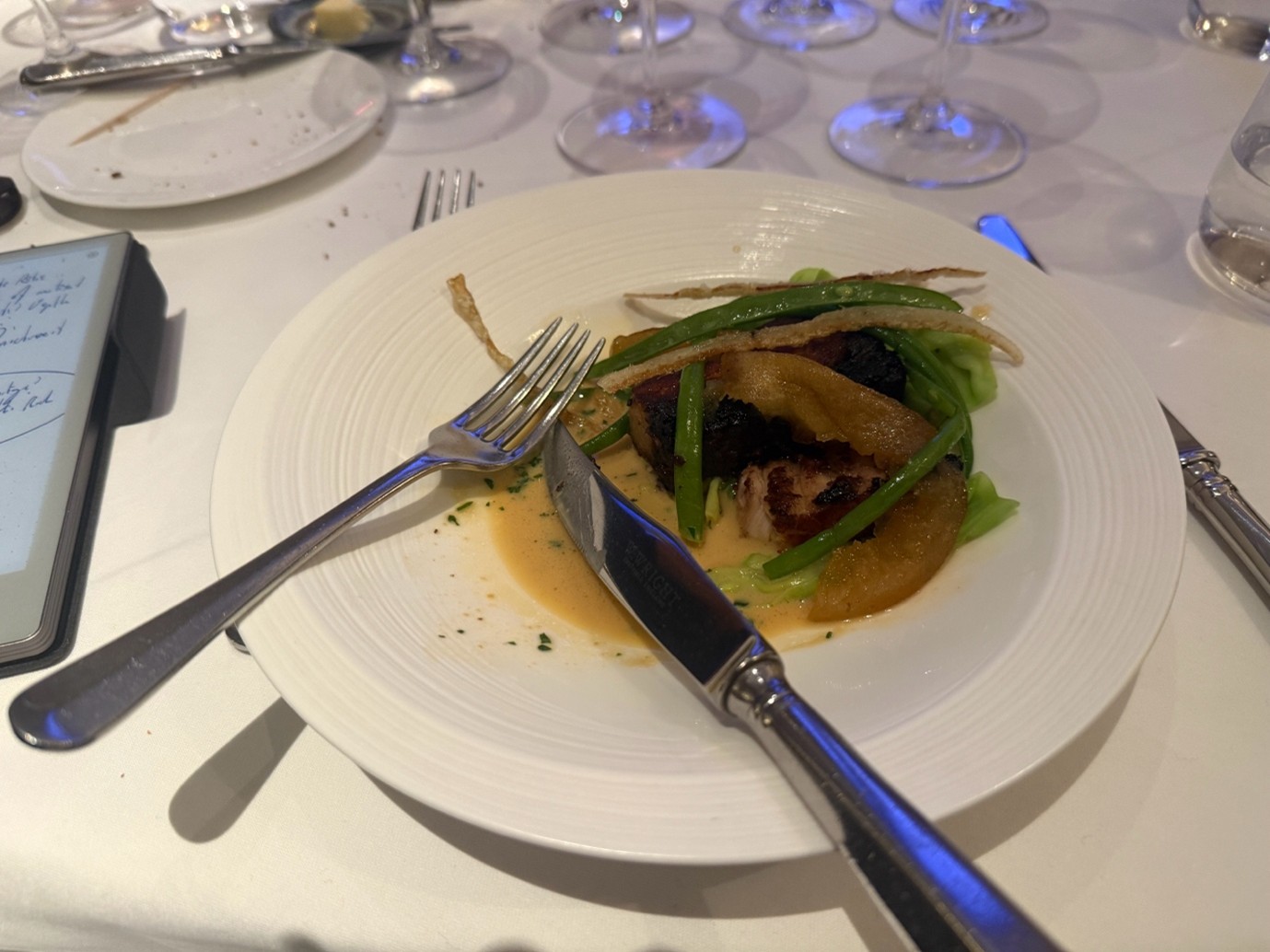
This is not what I expected, although I cannot claim to have been mis-sold. I was expecting a terrine made from crisp pork belly and black pudding. What I got was pork belly with black pudding on it. It was, again, delicious. It did not exactly match what was needed at that stage of the dinner. Coming in from a cold walk on a blustery day, however, it was hard to imagine anything better.
Hermitage La Chapelle 1982, Domaine Paul Jaboulet Aîné
No abv stated. Compulsory labelling requirements were not universal at the time of bottling.
Garnet colour, with the vaguest hint of bricking. A lovely nose. Raucous, like a country pub beer garden. There is some campfire there. On the palate, a surprising forward violet character, something tight and clean in the middle, and then at the finish it starts to get a little church vestry, tea leaf.
A fellow diner commented on a Rioja-like character. I think there is also an element of the wine simply becoming old. If you have these, it is time to drink them.
Hermitage La Chapelle 1989, Domaine Paul Jaboulet Aîné
13% abv. Slightly darker, with less bricking than its flightmate. A youthful nose, violets. This is wonderful Northern Rhône Syrah, and also clearly neither Cornas nor Côte-Rôtie. This is fully composed. There is a density of material. Fruit and soil are talking. This paints a detailed picture in the mouth.
It sparked a discussion about what makes Hermitage Hermitage. Rich, sweet fruit weight and rich, spherical body was how a fellow diner described it, and I can get on board with that. If this were the best red wine you drank in your life, you would have drunk very well.
Corn-fed chicken breast, stuffed morels, crushed potatoes, baby leeks and crisp pancetta.
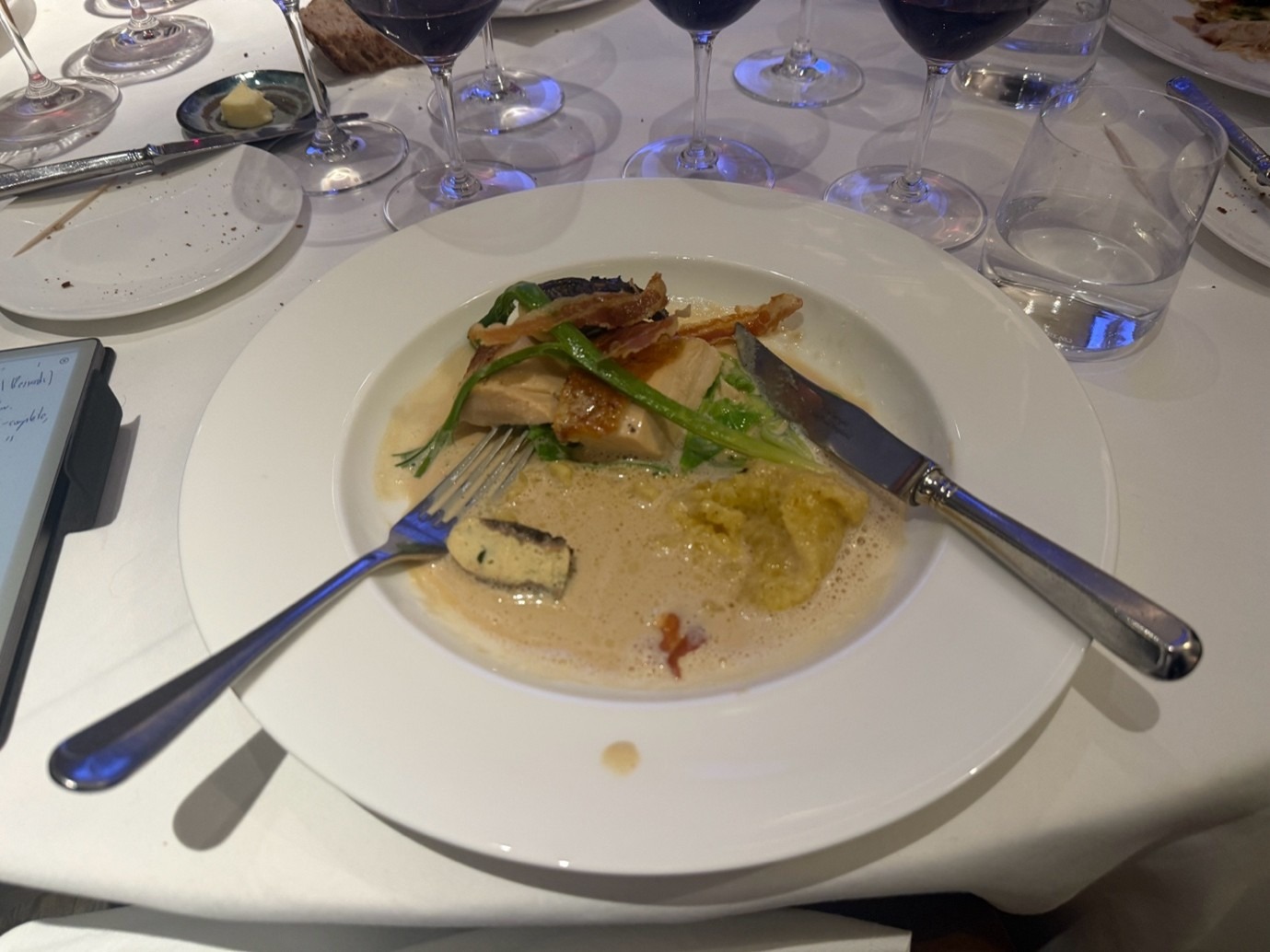
One of my secret shames is that I have never really figured out how to cook chicken properly. Good chicken is a treat. Getting hold of the good stuff in the UK is tough. Even when I do, it never turns out like this. Delicious, perfectly tender, the morels really set it off, and the sauce is tasty but not so rich as to overpower the delicate flavour of the chicken. It also matched the wines perfectly.
My tablemates all chose the steak and, for once, I was not jealous at all.
The wines of this flight were all from Bessards, looking out over the Rhône at the south-western corner of the hill of Hermitage.
Ermitage Le Pavillon 1990, M. Chapoutier
13.5% abv. Note the missing H. Purple garnet colour. An earthy nose with an almost baked character. The palate is complete, but ends a little short. The oak élevage is clearly perceptible. Oddly, this tasted the youngest of the flight. John Livingstone-Learmonth once ranked this as a five-star wine. It did not show like that for me, although CellarTracker notes suggest that at least some people are having exceptional bottles.
Ermitage Le Pavillon 1991, M. Chapoutier
13.5% abv. Older looking than the 1990, with some bricking. A hint of campfire on the palate. This reminds me of some 1975 clarets I tasted recently. There is a hint of volatility, and the oak, whilst less obvious, is still present. A fellow diner said “big, grunty Hermitage” and yes, it is.
It is less at ease with itself than the Chapelle. This is smoking cigarettes in a dank northern pub in the 1980s, and it knows very well how to hotwire a car. My notes capture the awkwardness of this wine, but there was a great deal about it to love. I could absolutely see why Livingstone-Learmonth awarded it a very rare six stars.
Hermitage Les Bessards 2001, Delas Frères
13% abv. The oldest looking by colour. It is odd that this flight seems to run backwards in time. There is a more lifted, energetic nose. A whiff of volatility on the palate, with lovely fruit character and strong acid at the finish. This is clearly Syrah, but of all the wines today, it is the one I would be least likely to pick out blind as Hermitage.
Three cheeses.
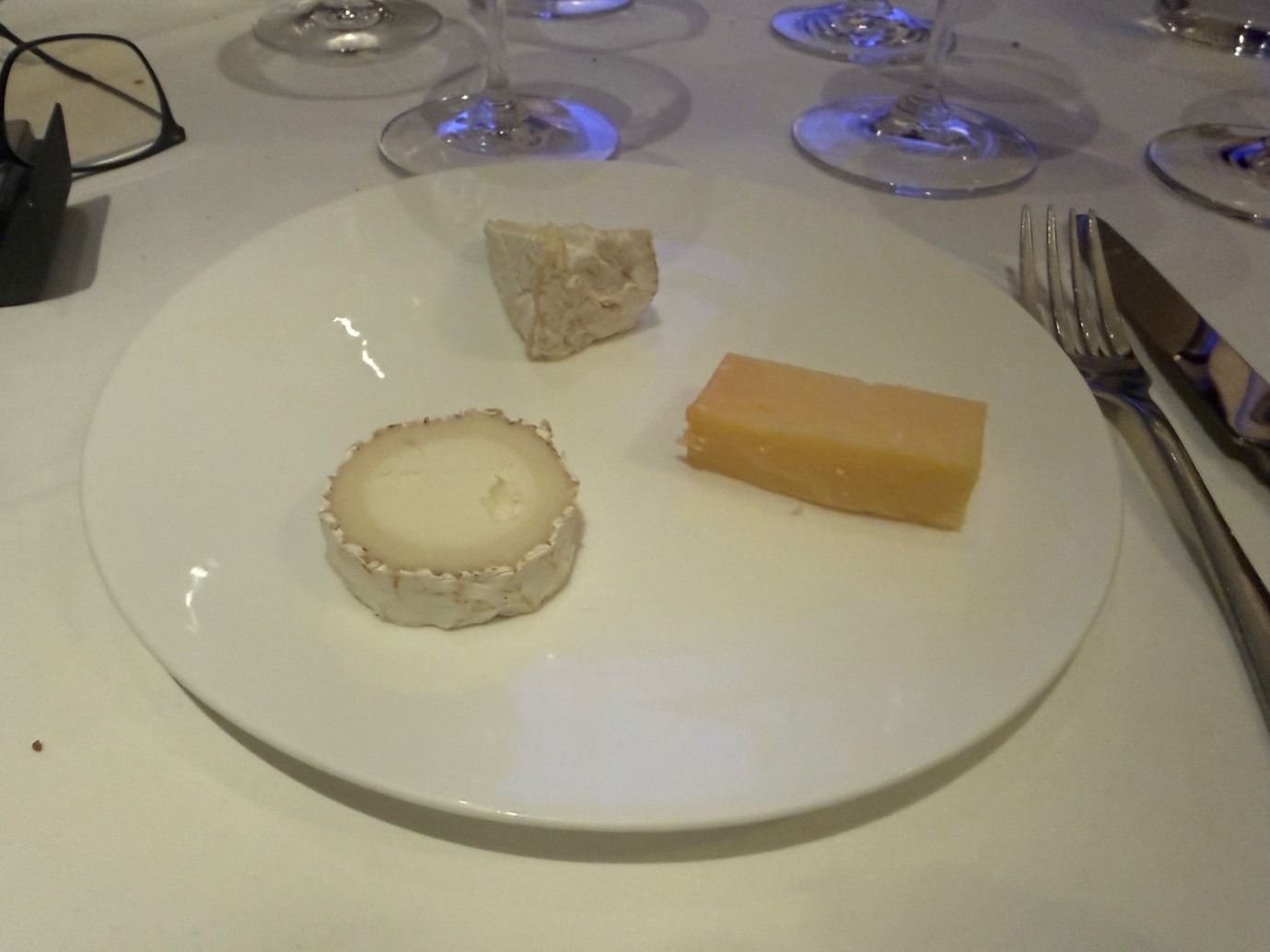
I was too well served at this stage to record the specific cheeses. La Trompette has one of the best cheese boards in London. Even so, I quite love receiving a small, no-choice cheese course. It feels neat, and brings the meal to a more satisfying and precise conclusion.
Hermitage 1998, Bernard Faurie (Red Cap)
13.2% abv. I only recently discovered Faurie, and there is a whole lore to it. Different coloured caps represent different blends from the vineyards of Le Méal, Les Greffieux and Les Bessards, and it is not documented anywhere what is what. Evidently one cap colour can mean one thing when shipped to the United Kingdom versus the continent. A very experienced fellow diner informed me that this is a blend of all three vineyards. The cap was red, the wine was red, and it was lovely.
Garnet colour. Very serious yet drinking so well. Violets, lovely concentration, and it comes together with a taut yet lingering finish. A fellow diner remarked that these wines have a wildness that Chave never has. I do not have a great deal of experience of Chave, but this certainly has great and engaging energy. There is breadth and clarity here. Wine of the dinner for me, and possibly the best wine of the year so far.
Hermitage 2011, Bernard Faurie (White Cap)
13% abv. White cap, and I am informed this is from Greffieux and Bessards. There is something on the nose. I wrote “coals, cassis.” Somehow mossy. We discussed what mossy means in this context. Do I mean stemmy? Yes, I think there is a stemmy character, but also a sense of concentration and material that is not quite where you expect it. Like when you mow the lawn and there is moss where you were expecting grass. I suspect this was tasted at an awkward moment, or that we had an awkward bottle.
What did we learn? I love these dinners where I get to learn from such experienced and expert tasters. I do not always agree, but I always learn a great deal. It is a wonderful thing about our little wine-nerd community that we are so generous with our thoughts as well as our wines.
I am starting to get my head around Hermitage. As one fellow diner put it, there is something about that weighty, spherical fruit. In some ways it is the most claret-like of the Northern Rhône appellations. It ages well. Some of these wines were still humming at more than forty years of age.


I am fortunate to have drunk both the 61 Latour and La Chapelle and with the Palmer are my 3 greatest wines tasted . Pity I did not know you when I had these 3 wines but hopefully we can at least drink the 88 Chave with perfect provenance this summer.
My favourite appellation for Syrah; in fact probably my favourite period !!
Sounds fabulous Keith. I seem to recall being the fortunate recipient of some of your Chave at a charity bash in the Ledbury back in the day. I don’t remember the vintage.
A lovely account of what I suspect was a lively assembly.
I find N Rhone particularly the whites a bit of a minefield inclined towards under delivery v expectation.Particularly in any stage resembling Youth.
Leon given your tender age you were not around when 61’s were around the forum and sattelitte dinners but perhaps fellow reader Keith P will be along with an observation…..or three😀