We wanted to go back to Cornus, having had a couple of really excellent lunches there. They have recently advertised their winter menu, which is more red-wine friendly. We thought this would be a good opportunity to try some excellent Cote-Rotie as well as some Rieslings (more about which later).
Cornus has been a very welcome entry to the London dining scene, especially for wine nerds. The dining room is light and airy, the staff are excellent and unobtrusive, and the food ambitious but not self-indulgently so.
They were the victim of an incredibly rude and unfair review in a UK newspaper, where one of the criticisms levelled was that there were customers in the restaurant wearing quarter-zip sweaters. In a silent gesture of solidarity, I visited wearing a quarter-zip – I am not sure if the staff recognised my support…
This was a thoroughly lovely occasion with superb wine, food and company. A big part of the pleasure for me was the discussion of the wines – some of it educational, and some of it convivially opinionated disagreement.
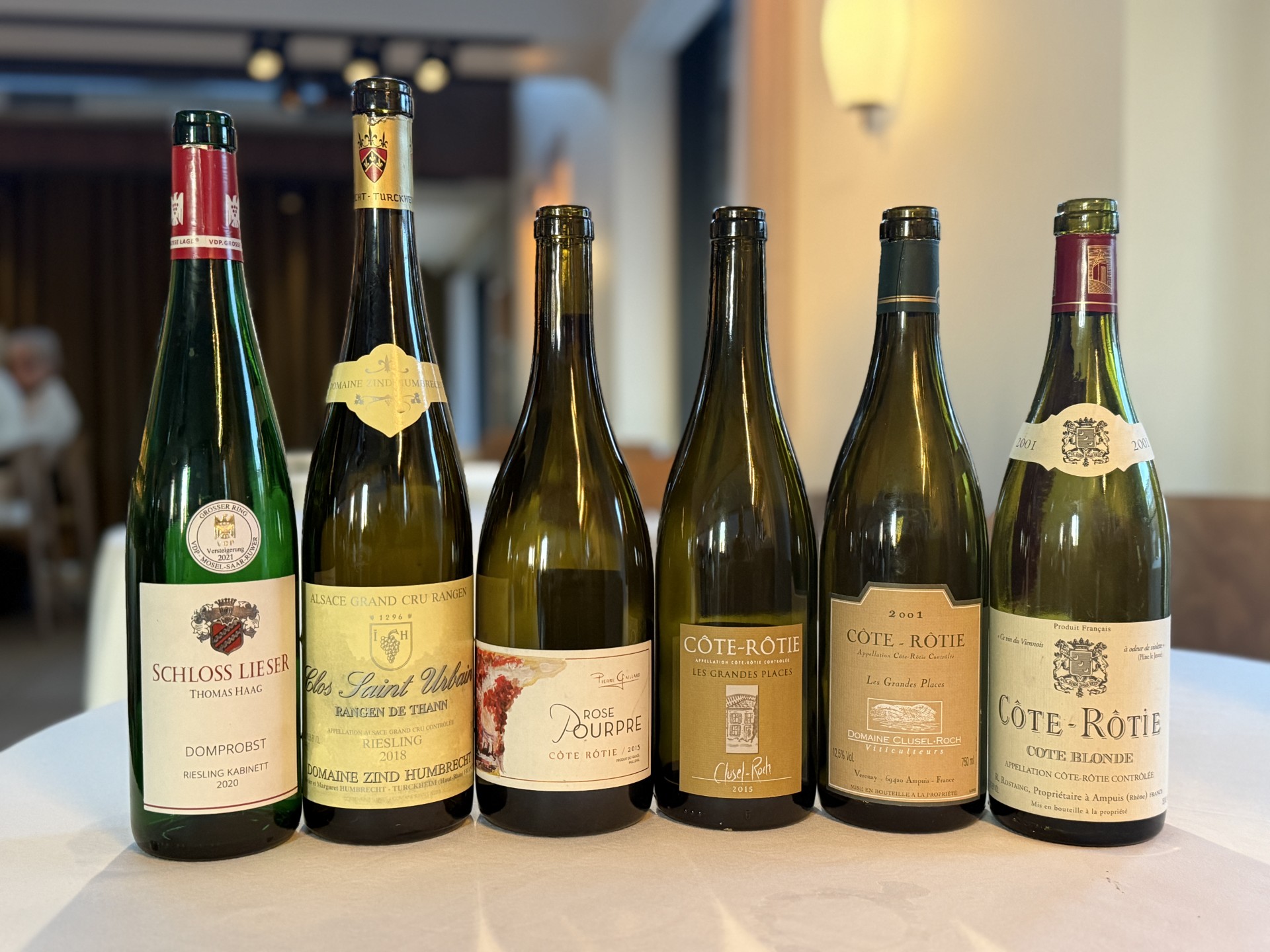
Riesling
Graacher Domprobst Riesling Kabinett Auction 2020, Schloss Lieser/Thomas Haag
7.5% abv. Part of the genesis of this dinner was a comment I had made about Riesling. I said that, whilst I had certainly enjoyed many Rieslings, I had never found one “transcendent” in the way that, say, white Burgundy or Rioja can be. “Transcendent” is a bit of a farty word, and I accept that it is reasonable to think that wine should not be described this way, but for me wine can sometimes elicit an emotional reaction in the same way that a piece of music or writing can. Anyway, transcendency test part one was undertaken.
Pale straw colour – almost green. “Electric sex bats” commented a fellow diner. Wonderful, expressive nose – just a hint of dragon’s breath. Fellow diners remarked that it became somewhat ethereal – they were left with a sense of just them communing with the wine.
Well, this is clearly very good, but I am not ready to transcend quite yet. I am informed that this would be more compelling either a couple of years ago, or sometime in the future. I can believe it. I am almost certain that this inability to fully grok non-dry Riesling is a moral failing on my part but, yes, this is clearly a jolly good wine, and no, it does not excite me.
Riesling Grand Cru Rangen de Thann Clos St. Urbain 2018, Zind-Humbrecht
13.5% abv. Woof. This is more like it. There is some discussion at the table as to whether this is austere. I do not get austerity, there is a piercing acid, laser focus, but there is depth here and an individual energy.
I am introduced to the concept of “dry extract”- this is the amount of stuff that comes out of the grapes into the wine. There is evidently a lot of if here, and it is lovely.
I am told Zind-Humbrecht wines of old were much sweeter, this is much more the type of Riesling I love. I am not prepared to say transcendent at this stage but… this is great. As I type out these notes, my mouth waters just thinking about it.
2015 Côte-Rôtie
Côte-Rôtie Rose Pourpre 2015, Pierre Gaillard
13% abv. Purple/garnet colour. Epic nose – you just want to dive in. Bacon fat? Maybe. Certainly some floral character. The palate tells a slightly different story. Initially I thought there was not much acid there but no, there is a lot. There just is not a lot of tannin to back it up
If the purpose of wine is to bring us together, this one did, even if only to talk about it. As it warmed up, the tannins became more perceptible, and there was some lovely blue fruit there. We had a discussion about the oak giving this a somewhat Bordeaux character, and like Bordeaux, this wine seems to leave one wanting just a little bit more.
This is a decent, well-made, even polished wine, but somehow doesn’t deliver the precision and bite I want from Syrah.
Côte-Rôtie Les Grandes Places 2015, Clusel-Roch
13% abv. More purple than the Gaillard – this looks younger. Much quieter on the nose, you really have to stick your nose in there and sniff. There is something floral, violets maybe.
A fellow diner commented “Fuck me, that is tannic”. Well, tannin can be wonderful. This is chewy and magnificent, in no way overbearing, but fully confident of what it is. There is a glorious tannic spine, and the fruit hangs off it gracefully.
This wine prompted a discussion on the nature of obliquity – how some types of pleasure can only be attained if approached sideways. If I only had a bottle or two, I would wait a while to open the next one, but this is singing. Yum.
2001 Côte-Rôtie
Côte-Rôtie Les Grandes Places 2001, Clusel-Roch
12.5% abv. Garnet colour, slight bricking on the rim. A fellow diner commented “The palate is waving goodbye”. Hmmm… maybe… To me this is gorgeous, has a kind of acid length. Starts off a little green but that blows off and this starts to sing. My handwritten notes say, “This is fucking mint”. With time and air this gets better – there are truffles.
This sparked a conversation about how old is too old. This was singing to me, but I can appreciate the other perspective. I go back to taste the 2015 again for comparison – I mean, yes, there is more energy, but this is fab. Like listening to Fleetwood Mac on a car stereo in the 1980s with someone smoking in the back of the car. There is all the leather there, but just a lingering hint of sweetness at the end.
Pleased to have another of these in the cellar, although I will concede to the proprietor that I should not wait too long before opening.
Côte-Rôtie Côte Blonde 2001, Réné Rostaing
12.5%. Deeper garnet colour, more particles suspended in the wine. There is a fully tertiary nose here – old soil, mushrooms. Not flattered by being tasted alongside the preceding wine; like Queen and Paul Simon, neither benefit from being on the same playlist.
I come back to this after the Grandes Places has finished. There’s a slightly volatile, high-toned character on the nose. A fellow diner remarks “Dusty, dry, no fruit, avoid”. I can accept that in this case, the wine may be too old.
I have another bottle each of these last two wines; I cannot help thinking that different bottles, on a different night, will give a very different experience. I will aim to open both soon. Best case, we have an even better experience. Worst case, we have some aristocratic gravy.
I believe it used to be said that Côte-Rôtie should be drunk between ten and fifteen years of age. On this showing, I can start to get behind that. Certainly, it does not seem to make as old bones as either the more aristocratic Hermitage or the more brutally rustic Cornas. With that said, I think I do have a taste for older wines than some, and if I were at home, neither bottle would have ended up down the sink.


I fully understand that one can really want one’s wines to show well, and even be more positively disposed to them than perhaps one should be but ‘gorgeous’? ‘Starts to sing’? ‘Truffles’? Madness.
There was a person I knew, he was not a friend, who once lectured me at enervating length and nigh violence inducing presumption that over-mature wines have ‘a wondrous decadence’. They most certainly do not.
Over-mature wines taste thin, dusty and dry. They have more than a hint of an ossuary to them. This is exactly the character of these wines, and they clearly stopped communing in any pleasurable tongue a number of years ago.
You say the 2015 Grandes Places ‘had more energy’ than the 2001, you did not mention that it also had fruit, structure, depth, complexity, character of the vineyard and charm. The wines were poles apart. The 2015 Grandes Places was delicious and approaching its peak, a wonderful wine. The 2001s were so advanced into their journey crypt-wards, they were in danger of leaving through the back wall.
They were ex-wines. They had ceased to be. Bereft of life, they rested in peace. If you had not pulled them out of your cellar, they would be pushing up the daisies. They were dead wines.
For my part, I had one worrying taste of each, then limited myself to occasionally sniffing to confirm they were only getting stiffer than a honeymoon night. I refused any top-ups.
You are right that your other bottles might not be as hyper-cadaverous as these. It is always possible that when one opens really old wines, some bottles are dead and a very few miraculously survive – they can even be excellent. So, you may be in luck! Perhaps you will be good enough to share that slight chance of a positive experience with people other than The Editor and me.
Oh, one last thing. You own a magnum of the execrable 1993 vintage, a thirty-two-year-old wine from the second-worst vintage of the 1990s (1992 was marginally more abysmal). I bought one of these from Bastard Lea and Bastard Bastard Sandeman the (dead) Bastard on release and took it to a party. I got so little action I may as well have been at convent hosting a chastity-belt convention. If you open this when I am present, I will cry.
Ha! Is there a chance of autosuggestion and forcing myself to enjoy these wines…maybe a *little*, but there is also something profoundly joyous about the tertiary characteristics of wine, and more than any other grape I think, syrah goes through some sort of alchemical reaction as it ages.
I have another pair of the 01s which I am planning to serve over the festive season – best case they will be exquisite, worst case we will have some very fancy stew.
EDITED TO ADD – ha, I see I am repeating myself from the article itself. Well. It remains true. I shall report back.
It is possible to fetishise the taste of mature wine that one convinces one’s self that wines that are very clearly past it, are showing a ‘wonderous decadence’ of tertiary character. Surely not you, Leon?
Just as one can appreciate the characteristics of aged wine, it is important to realise when it goes too far. The storied Paul Day once opened at bottle of Mouton ’61 for Peter, The Editor and me at Noizé. We were all quite excited as it was poured. Then we all laughed as we, almost gleefully, said, “Totally knackered!”
I also suggest that you have backup bottles on hand.
Fabulous writeups from you both.
Loving the idea of obliquity too. I really know what you mean.
Leon made a good point there; one had to think slightly sidewards about the loveliness of that wine. It was undoubtedly lovely, though, and a real joy to drink. After the slightly odd Rose Pourpre, this was all one could ask from a Côte Brune wine in its prime.
I have to admit, I was slightly embarrassed to have brought the Rose Pourpre. It is from a great lieu-dit – Côte Rozier – and a great vintage, but I think M. Gaillard made a sow’s ear from a silk purse. Educational to taste, but I apologise for bringing that, chaps. We wanted excellent wines for a celebratory meal.
I think it was perfectly decent – and indeed, I think many people would have preferred it to the GP. Overall we did excellently!
Ah, but I did not pleasure *myself* immensely with that bottle. It cannot be denied that, once we had got over the initial loveliness of the nose, most of our comments were of the somewhat non-plussed level.
I would like to open a 2012 Vernay Maison Rouge with you, Leon, I have a couple left. It is a fully mature Côte-Rôtie from a first order terroir. We must arrange to meet.
A most enjoyable read. Obliquity, transcendence, decadence, fetishes, chastity-belt conventions, ossuaries, honeymoon stiffies… I’ve visited ossuaries (the catacombs of Paris and Rome) and they are places that invite deep reflection.
Look, I think the extremism expressed in some of the comments does what extremism often does: it misses that subtle spot where contrary views overlap, where truth sometimes resides.
I didn’t taste these wines, but one person’s over-mature wine is another person’s ancient portal into the past.
“Over-mature” isn’t helpful because it’s tendentious: by using the word “over” you’re already implying it’s past it. So that’s cheating. Don’t cheat. “Wondrous decadence” is a misnomer: decadence as a concept has a moral dimension (used by the Soviets to denounce Western values or the bourgeoisie, and used by the modern far right to denounce liberalism or progressivism). A more detached view would use the word “decay” rather than decadence, which would be completely accurate, and is neutral. Many things that are decaying are beautiful: autumn leaves on the ground, deadwood gathering fungi and growing moss, abandoned buildings, rusting metal…
Very old wines (full disclosure: I love them, but I am making a case here, not just talking about my personal preferences) can develop astonishing levels of complexity, and exposure to oxygen kills them quickly, so every glass is an emergency. Every glass is different – it is the dying breath of something that has survived for decades up to – perhaps *for* – this moment.