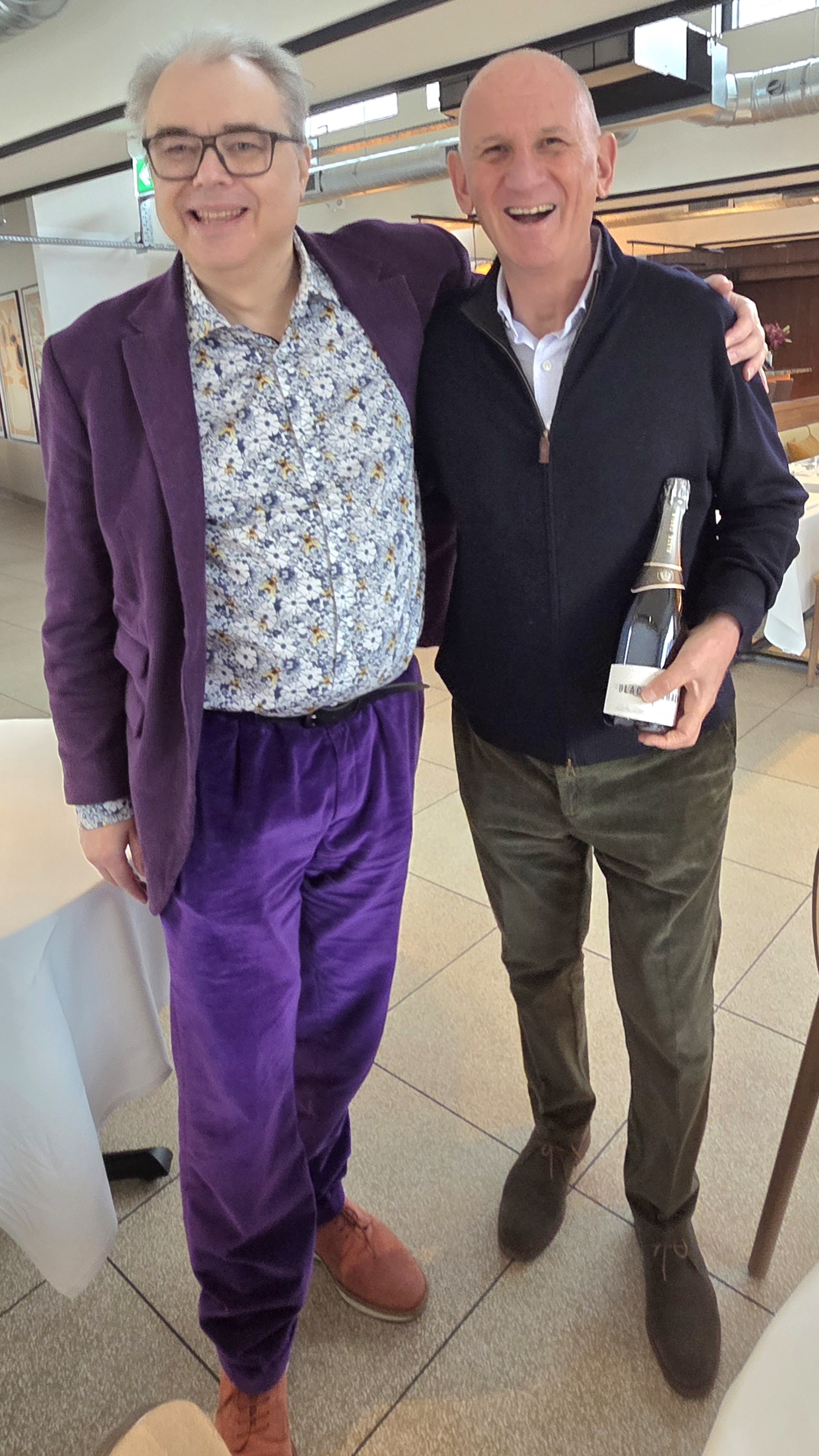
Davy and Jonathan
Our first spiritual home required a rejection of the hegemony of chalk. Nyetimber’s Tillington vineyard sits atop a rare seam of Greensand. It allows the vines to ripen with a lubricious enthusiasm unknown to their frigid neighbours on the hills of Southern England.
The resulting wine is a creature of unusual power and density. It is a devastatingly handsome rugby-player in a world of waif-like ballet dancers. This is English wine with the volume turned up to eleven, possessing a sui generis that mocks the very concept of fizz.
We were then transported to the terrifying, vertiginous slopes of Alsace’s Sommerberg Grand Cru. In a region threatening to turn into a Scandinavian sauna, this vineyard remains a bastion of crystalline austerity.
In the hands of Jean Boxler – the King of Niedermorschwihr – this Riesling is not a beverage, but a weapon. It is a rapier of focused acidity that slashes across the palate with gelid precision. It vibrates with the frantic energy of existence itself.
Our third stop took us south to the Maison Rouge lieu-dit, a sun-drenched amphitheatre in the Northern Rhône. As one of the most southerly vineyards of the Côte-Rôtie’s Côte Blonde, it occupies a space where Syrah’s thews are tamed into something ethereal.
In the artistic hands of Christine Vernay, the fruit is transfigured into heavenly vinous perfume. It is a wine of lace and violets, proving that true sublimity lies in elegance rather than brawn.
We leap to the Southern hemisphere and arrive in the fourth spiritual destination. This is not a vineyard, but the alchemical blending vats of Chris and Andrea Mullineux in the Swartland.
Deep within the cellar, many vintages of impossibly concentrated straw wine are married in a fractional system known as Olerasay. This is a reductive mingling of years, a perpetual reserve where fresh vibrancy wrestles with aged depth to create a complex melange that defies the linear passage of time.
We arrive at our ultimate destination and convivium: Restaurant Cornus. At this one-star, high above the Belgravia bustle, one finds perhaps the finest food currently available in London, served with a refined grace.
The value is startling; a six-course set lunch of this calibre is practically charity. However, the true wonder lies in their enlightened corkage policy, twenty coins a pop at lunchtime. This is a gesture of such benevolence it brings a tear to the eye. It allowed us to unite these disparate vinous locales in a single, glorious lunch.
Just a word about the company.
I have been swapping emails with Jonathan for a couple of years now. Every few days I send him an incoherent (but occasionally inadvertently hilarious) screed, and a day or so later I receive a very balanced and reasonable reply from him that usually has the subtext, “Do not worry, calm down – you will be fine.” Therefore, I thought he would be reasonably nice and worth meeting.
I was not prepared for what a fabulously charming, humorous and personable chap he is. Unlike a lot of people, he is immeasurably more wonderful in the flesh than in emails. It was a rarely paralleled delight to dine with him, and I sincerely hope he will consent to meet again.
Thank you for paying my share of the bill, Jonathan! My review of our wines below, the first three I provided, will hopefully make my reader understand that, whilst this was exceedingly generous of you, I made a reasonable stab at pulling my own weight.
Alex, too, is one of the most balanced and charismatic people one could wish to meet. He has been a tremendous friend when life-buggering pain or rampaging insanity have prevented me from leaving Winchester. I am glad we can now meet you half-way, Alex, and I invariably feel wonderful on such occasions.
The Editor… Ah… I cannot even go outside to the bins without The Editor coming with me (zombies, that I am told are hallucinations, you see?). He is so limitlessly lovely, I would be overjoyed if this arrangement continued. He tells me this is not an inconvenience, and I do not need to apologise to him in this article!
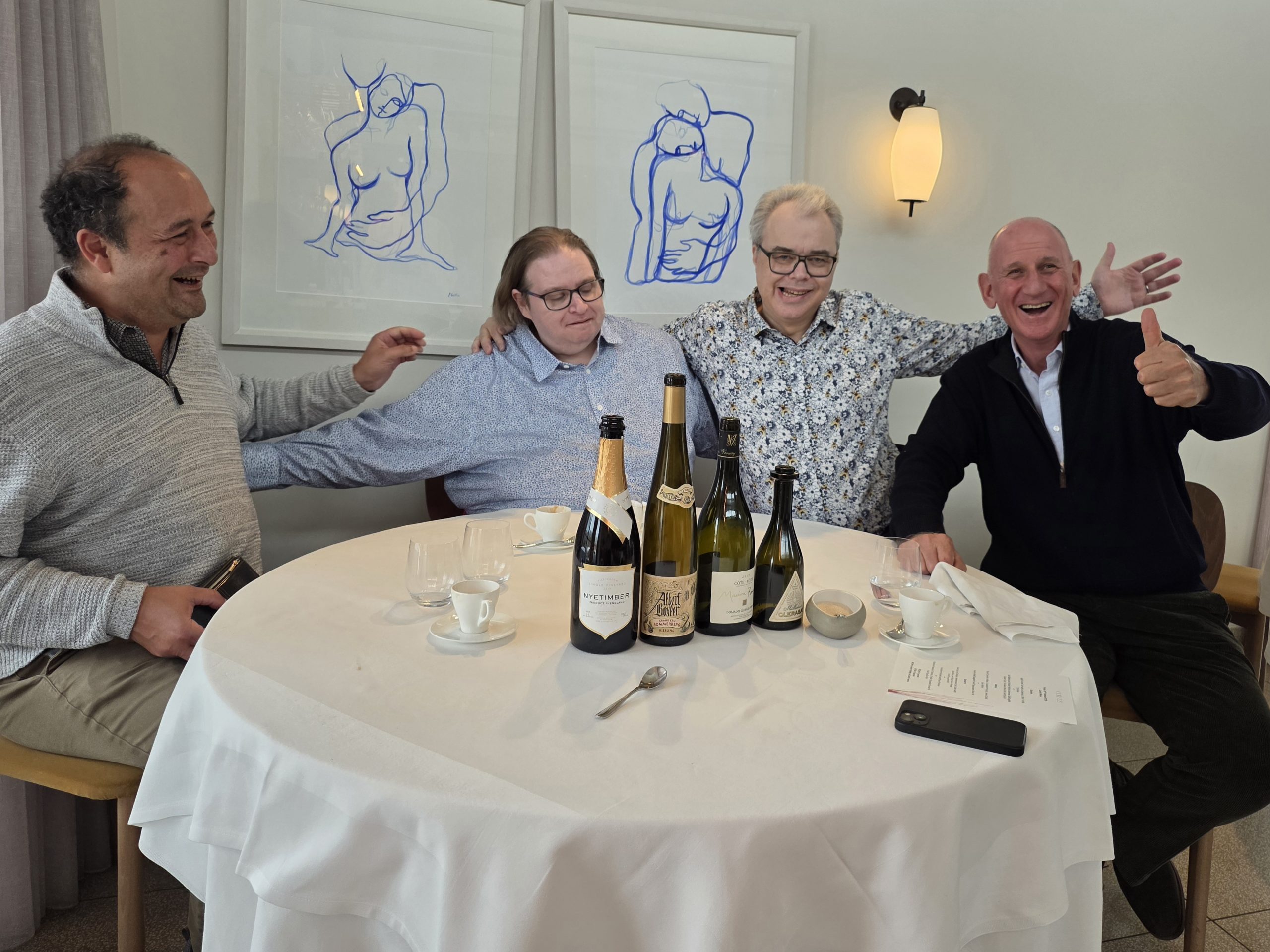
Alex, The Editor, Davy and Jonathan
Drinking for a quality lunch follows!
Tillington single vineyard sparkling wine 2013, Nyetimber
This has the obvious power of ripe Pinot Noir fruit on the nose. Whilst it seems vastly denser and more weighty than most English fizz, it has the essentially English character of a profound depth of fruit, resultant from the extended hang-time the fruit gets on the vine.
With all that fruit the wine smells alive, vibrant, and vivacious despite the real power on the nose. This power is very impressive, in the absolute least pejorative meaning of that word. If the wonderful Black Chalk is Milla Jovovich, this wine is Maro Itoje – no less attractive, but a world away in terms of physique.
This is caused by the Greensand of the Tillington vineyard keeping heat for longer than the usual chalky soils English fizz is grown on, and therefore allowing the ~70% Pinot Noir in the Tillington vineyard to get extra ripe during its long ‘beauty-treatment’ hang-time on the vine.
This wine does undergo extended ageing on its lees but it is not overtly autolytic. It is not, nor is it trying to be, an attempt at mimicking Champagne. Not only does it have that long hang-time fruit, but also it is charged with the thrilling energy of an English sparkler. It is infused and invigorated by a rapier of acidity that keeps the wine thrillingly fresh.
‘Freshness’ seems very much a theme with this wine. Alex, The Editor and I shared a bottle of this a couple of years ago and it seemed much more advanced and less joyfully exciting.
There are a myriad of involute fruit flavours and non-chalk mineral characteristics on the palate. It is also extraordinarily long. My, what a stunner!
Is this wine good? Yes! It is an exciting, awesome, and authentic expression of a rare English terroir that has aged gracefully whilst losing none of its energy nor the unique fruit of English fizz.
Is this wine worth its enthusiastic price? Surely thou kiddest.
Was this wine worth opening for a valued friend whom has never tried English sparklers? Depending on your definition of the word, this is the ‘best’ England has to offer; yes, absolutely.
Will I buy and open this wine for Jonathan again? Ha! What to you think I am? A madma… oh…
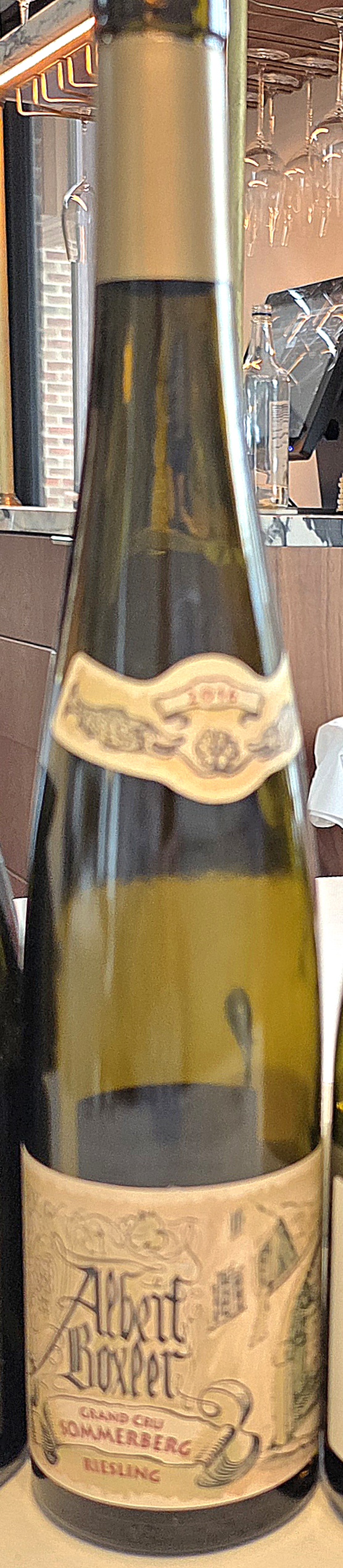
Riesling Grand Cru Sommerberg 2016, Domaine Albert Boxler
I can smell this when it is being poured for Jonathan sitting next to me. A heavenly, complex aroma of creamy minerality and plush, ripe limes.
I get some and sniff it. Bof! That is a big, powerful ripe nose of considerable density! It is also incredibly detailed with its complex citrus scents, exotic fruit characteristics and scintillations of beguiling minerality. What a stunner.
Whilst the nose is definitely perky and fresh, there are definite signs that the wine is beginning to mature. The citrus aromas are developing the aged complexity that some people call a petrol fragrance. It always seems more the complex interplay between mellowing citrus elements than octane to me, but I see where they are coming from.
Two of our number suggest this has the nose of a white Rhône wine. I do not name them as Jean Boxler would hunt them down and thump them! I, too, baulk at this. Sure, it is big, but the fruit character is wildly different, and the scents are far fresher than any Rhône white.
The palate is big and mouth filling with a great density of fruit, a complex stoniness and charged throughout with vivid energy. Riesling grown on granite is a magic combination, if the vines are well cared for the wines will have these characteristics in abundance. This Riesling does not hold back in these regards!
It is nigh impossibly long, I will be tasting this tomorrow! The involute excitement of flavours on the finish is hard to underestimate. What a stunner! All that line/lemon fruit! All that stoniness! The thrill of energy running through it! Phew!
This is only beginning its journey into maturity – I would wager it has another decade of pleasure-giving life in it. Riesling from granite soils can last and last, and this certainly will do so!
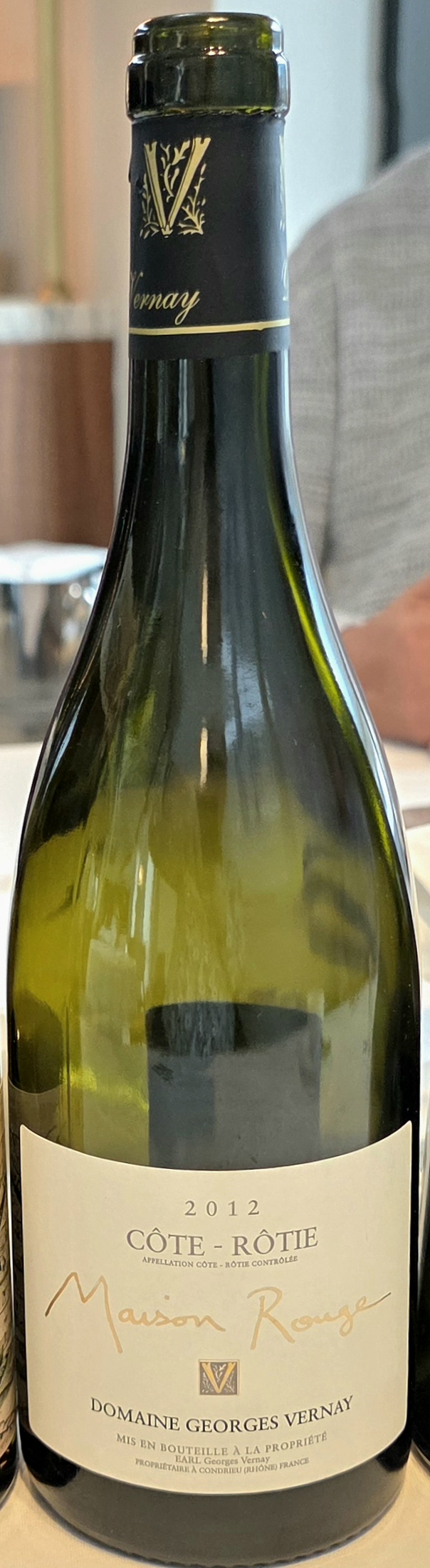
Côte-Rôtie Maison Rouge 2012, Domaine Vernay
Maison Rouge is the second-best lieu-dit on the Côte Blonde, making extremely beautiful wines from the ‘beautiful’ end of Côte-Rôtie.
And is this not beautiful? Delicate scents of violets and bacon fat intertwine with soft, mature fruit and a refined earthiness. It is almost painfully winsome!
There is nothing excessive, nothing overblown, nothing heavy about it. All its elements are in ordered harmony and sing together a wonderful song of elegance, sophistication and pure love.
I am advised I am worrying too much about one characteristic on this wine, which is that it appears to have received a bit too much new oak for my tastes. Such is the ravishing beauty of every other facet of this ethereal, harmonious essence of Syrah, I will follow this advice (for a change).
Hell’s teeth, the luminosity of the palate eclipses the radiance of the nose. Such a delicate expression of Syrah; no rough edges, no hardness, no tough tannins. It speaks with a graceful voice of pure charm.
The fruit and tannins are fully resolved and are laced with a trace of energy that makes the palate bloom with desire and allure. This is at its very peak of perfection now and can be enjoyed with complete delight.
I noticed Berry’s were selling a six-pack of this recently with a suggested drink by date as the end of this year. I think they are right – approximately, as all these things are, of course. This is at the zenith of harmony now, and it will not get any better.
Drink up and enjoy its exquisite delight sooner rather than later. I have judged the time of drinking my final bottle very satisfactorily.
Olerasay No. 1, Mullineux
There are a complex melange of candied, raisiny aromas on the nose; it smells very inviting, sweet and decadent.
However, I had a bottle of this with Alex a couple of years ago, and since then it seems to have lost some complexity, intensity and freshness. I feel a bit churlish saying this given that Alex has been kind enough to share another bottle of this rare wine with us but, as you know, I try to tell it like it is.
When people try ultra-sweet wines they invariably say that it will last and last and it will improve for N decades. This is only occasionally true. Most intensely sweet wines need drinking up before any complexity they have bound up in them gets swallowed and subsumed into the sweetness. Super sweet wines need drinking young.
I recently had a Riesling Quintessence de Grains Nobles 1989 from Deiss, I commented on it:
This wine struck me as being very much like that loon Alois Kracher’s efforts: all sweetness and acidity and… anything else? No. Despite being packed with sugar, it was very much like my testicles after a night with A***** ‘Big Tits’ G******, clanging with hollow emptiness.
This Olerasay No. 1 was not shallow compared to that wine, and incomparably better than the silly and not entirely nice sweeties of Kracher, but it is time to drink. If Alex has any left, I suggest he gets cracking (or sells it).
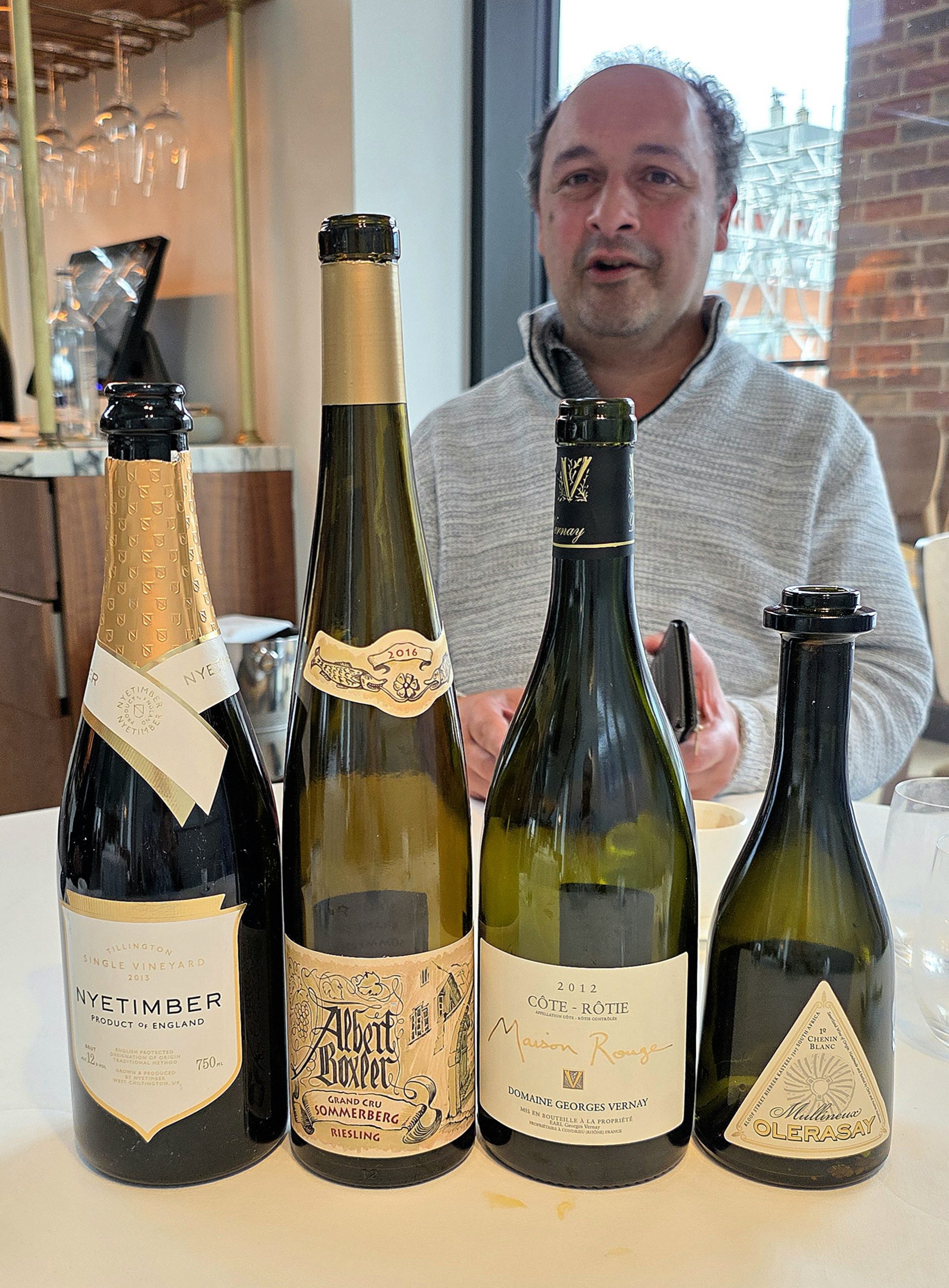
Alex and the wines


What a superb piece Davy. You have excelled yourself and that is quite a statement to make considering the high bar your reviews set . I was slightly surprised to read your comments on the Olerasay No 1 as the last bottle I tried of this, only a few weeks ago , was absolutely stunning. And the standard Straw wine is infinitely better after 15 years than the first vintage in 2008. And I drink these every year . I wonder whether that bottle you tried had dodgy provenance——-you know that Alex guy is a bit dodgy himself 🙂
Thank you, keith! I really find these things are better when they’re young. But I have some of the standard straw wine, and I will try keeping it until it is fifteen. I’ll get back to you then 😊
Well I am comparing the original 2008 which had unbelievably high RS and this was toned down a touch over the years . I always disliked the original vintages but, as you know, Neal Martin and others raved about them and they were the main reason for the initial success of Mullineux . However, 15 years later and I love the wine. No longer a sugar bomb , much more complex and interesting.
I have some of the 2020, and I shall keep it until 2035 and let you know what I think about it then. If it’s better, then I’ll buy you a pint!
Davy,
It as marvellous to finally meet you, and Dani and Alex. I had a very enjoyable time with excellent company and food. The wines were uniformly of the highest order (not withstanding your feelings about the Mullineux) but the Boxler was from another planet and the memory of it still lingers. Given that you contributed three bottles of superb wine, the least I could do was to try and balance things out a bit.
Looking forward to the next time.
Ah Jonathan, we have just come back from drinks in Oxford. We came back via Bournemouth which is 45 minutes South of Winchester. That sleep has left us with slight headaches.
But I digress. It was wonderful to meet you and have a great lunch with great wine. I did not think the Mullineux was by any means bad, just less fresh than last time I had it. You are certainly right about the Boxler, that is one of the finest wines available to humanity.
Please come back to London, and please agree to see us again! I will bring fine wine and we can eat somewhere less vastly expensive. We had so much fun. Judging by the pictures, you did too! Let us hope it is not too long until we can do it again!