RZ, a friend of the Elitistreview and a long time Rioja aficionado, wanted to organise a dinner based around the wines of Compañia Vinicola del Norte de España (hereafter: CVNE). With around 1000 hectares of vines, they are one of the largest producers in Spain in terms of vineyard holdings. They have several brands. The basic CVNE line is stocked in Tesco and the Co-op throughout the British Isles. Imperial and Viña Real are more serious wines, of the type that is more frequently written about in these august pages.
Rioja is a fascinating region. Uniquely among major European wine regions, they still make a great deal of use of American oak. Rioja has been producing wine since at least the first millennium, but they got their big break after Phylloxera struck down the vines of France. The negociants of Bordeaux came seeking wine to sell, and the winemakers came seeking work.
At that time, the cheapness of American barrels led producers across Europe to adopt them. For some reason, it is only Rioja that has kept using them. There is something about the character of American oak that gives some Rioja a distinctive quality. Much like my beloved Ridge, these wines have a kind of high-toned, Technicolor energy. They achieve both high saturation and full authenticity.
As with many regions, global warming has had an impact on alcohol levels. Recent vintages of the Riojas you love can get scarily close to 15% abv, or even higher. However, in the vintages we were tasting, Rioja was a reliable source of wines with intensity and structure. You could drink them in some quantity without getting utterly hammered.
A note on the venue. I am a big fan of the Laundry in Brixton, although the Elitistreview’s proprietor and The Editor are not. I made them go there once on a day that was far too hot to drink red wine. Tuesdays are free corkage nights, and the food is good. The quality is high and it works well with wine.
We each had two starters. I had salmon rillettes on crumpet and venison salad. For mains, the whole table took the rack of lamb. The total damage was £62 per head, including service. This seems more than fair value in these straitened times.
Gravonia
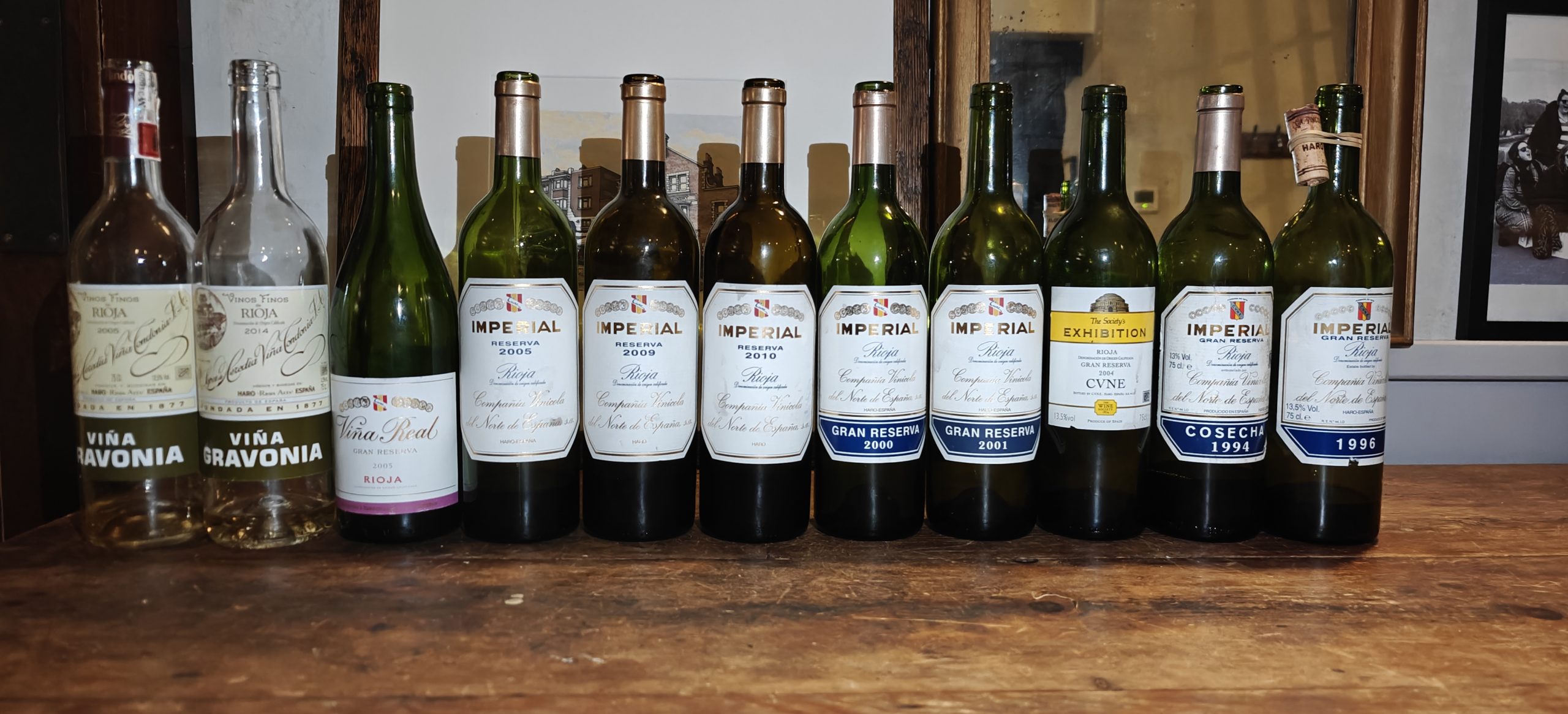
Rioja Blanco Viña Gravonia 2014, Lopez de Heredia
12.5% abv. Paler in colour than its flightmate, deep gold. On the nose, hints of grapefruit over the sherried, oxidative character. There is a waxiness on the palate. This coats the mouth entirely. Your gums can feel it is in there. Long finish. This is absolutely at the oxidative end of Rioja and if you do not like that, you will not like this. There is also a kind of clean astringency on the finish. This is saying something pointed, but it also has a purity to it. Sparked some discussion around how much of a wine like this you could drink. I think half a bottle might be too much, but a quarter would be a pleasure.
Rioja Blanco Viña Gravonia 2005, Lopez de Heredia
12.5% abv. A wine I have tasted several times, mostly due to the generosity of the organiser. There is something slightly musty on the nose. TCA? I do not think so. Certainly, there are flavours in here that are far from muted. Real sherried finish, and a note of linseed oil and butter. Interestingly, my half of the table seemed to agree that this was disappointing. The other half of the table thought it the equal or even the superior of the 2014. Well, wine is a mystery, is it not?
2005
Rioja Viña Real Gran Reserva 2005, CVNE
13.5% abv. Comes in a Burgundy shape bottle. Garnet colour. Red fruit, with a bit of violet on the nose. The American oak character is clearly there. Some vanilla ice cream, with the high-toned fruit notes, but all is in balance. There is a lovely finish. My handwritten notes say “Clarety”. This seems very fairly priced on the market. The excellent 2015 is under £30 per.
Rioja Imperial Reserva 2005, CVNE
13.5% abv. This one comes in a Bordeaux bottle. A purpler colour than its flightmate. It is a little more concentrated. It is drawn with a slightly finer nib, but I also got a bit more heat on this one. A slight baked character on the nose, and stewed apple on the finish. None of my fellow diners perceived this, so perhaps something I am oversensitive to. I would not class this as faulty by any means, but clearly a stride behind the Gran Reserva Viña Real.
2000s Imperial Reservas
Rioja Imperial Reserva 2009, CVNE
14% abv. Garnet colour. Reminds me a lot of the Ardanza from the same vintage, which I have been drinking through at a ferocious rate. The nose is tobacco, earth, dark fruits, some vanilla and spice. Not quite Christmassy. The mouthfeel is lovely. I hate to admit it but perhaps the 14% alcohol helps here. There is a savoury character, and very good length. The tannins are not yet fully resolved, a slight pleasing grip at the end. Of the flight, I preferred this.
Rioja Imperial Reserva 2010, CVNE
13.5% abv. My handwritten notes say “like the last, bit hotter, more concentrated”. This felt less ready, a bit spikier. If someone said “I do not like Rioja” you would not use this wine to try and convince them otherwise. Slightly jarring oak character, still a bit high toned. I could imagine that this is just a bit tightly coiled at this stage. In a few years it would be the better of the two wines.
2000s Imperial Gran Reservas
Rioja Imperial Gran Reserva 2000, CVNE
13% abv. Garnet colour. Lovely red fruit on the nose. This is starting to get tertiary. On the palate, grip, red fruit and lovely acid. A long savoury finish. Mature Rioja is a treat, but this still has a way to go.
Rioja Imperial Gran Reserva 2001, CVNE
13.5% abv. Hmm, even just smelling it becomes obvious. Corked, corked, corked, corked, corked! Ah well.
The Society’s Exhibition Rioja Gran Reserva 2004, CVNE/The Wine Society
13.5% abv. A generously opened backup, tasted without the benefit of double decanting. This a bottling from UK retailer The Wine Society’s Exhibition range, which aims to show archetypal wines of various styles. They are usually solid, if not wildly exciting, and by that measure I think this overperformed. Lovely red fruits, maybe a little less complexity than the 2004 which preceded it. A lovely character on the finish. Somehow reminded me of Raspberry Chewits, a 1980s English sweet.
1990s Imperial Gran Reservas
Rioja Imperial Gran Reserva 1994, CVNE
13% abv. My handwritten notes say, “up a gear!” Indeed. There is depth and complexity here. I think we are finally getting to the real joys of mature Rioja. Fully tertiary characters in a wine that is being held up by great acid and tannin. A vigorous middle-aged man who can still run a marathon, ski a black run and can sail a dinghy around the Solent. In the middle there are stone fruits, and a savoury finish with just a hint of spice.
Rioja Imperial Gran Reserva 1996, CVNE
13.5% abv. Immediately obvious that this is the wine of the flight, the wine of the dinner. There is more structure. It holds itself more confidently on the palate, but also a bit more generosity to the fruit character. This is just more complete. I find myself wondering if the half degree of alcohol gives it a more complete feeling in the mouth. Either way, if you have some in the cellar, lucky you. No need to rush but lovely drinking just now.
So, what did we learn? Well, Rioja offers jolly good value for wines that last for a long time and are really engaging as they age. But I think we knew that already.
Except for the 96 Gran Reserva, no real fireworks for me. Just very decent, solid wines that are reliable and good value. If it were not for the fact that, at current rates of consumption, I have enough decent £20-30 red wine to last me until my 128th birthday, I would probably be in the market for more wines like this.
The one question I have is this: With global warming, and increasing alcohol levels, will Rioja continue to be a refuge of quality and value?


Who could not possibly love the Laundry ? Davy and the Editor need to refine their taste buds . Of course, I am slightly prejudiced being an investor, as is my son 🙂
Cheers Keith
Keith, the one meal I have had there was abysmal, truly dreadful. At the start of winter, when it was already getting dark early, we left surrounded by a miasma of depression.
However, since everyone says good things about it, and it will be indirectly paying you a few coins, I will try it again, if The Editor agrees, obviously. If it is as bad as last time, I will expect compensation in the form of a six-pack of wine of my choosing!!
Mmm,
Too many questionable or faulty mentions in one line up for me
And all the wrong colour for you too Ray 🙂